How Auto-Renewal Works in Subscription Billing Systems

How auto-renewal works in subscription billing systems: understand billing cycles, payment retries, subscription states, and automated renewal logic in digital platforms.

How auto-renewal works is a key concept in subscription-based pricing systems. Auto-renewal allows digital services to automatically extend a customer’s subscription at the end of each billing period without requiring manual payment confirmation.

Instead of asking users to purchase access again after every billing cycle, subscription platforms store billing information and trigger automated renewal charges. When the renewal process is successful, the subscription period is extended and the user retains uninterrupted access to the product or service.

Understanding how auto-renewal works requires examining subscription lifecycle management, billing schedules, payment processing systems, and retry mechanisms.

These mechanisms operate within broader subscription architectures that define recurring billing intervals and lifecycle states.

Auto-renewal is not simply a recurring charge — it is a coordinated system that manages time-based entitlements, financial transactions, and access control across billing cycles.

Within the Pricing and Billing Systems pillar, auto-renewal is closely connected to subscription models, free trials, usage-based pricing, and SaaS pricing tiers.

Clear System Definition

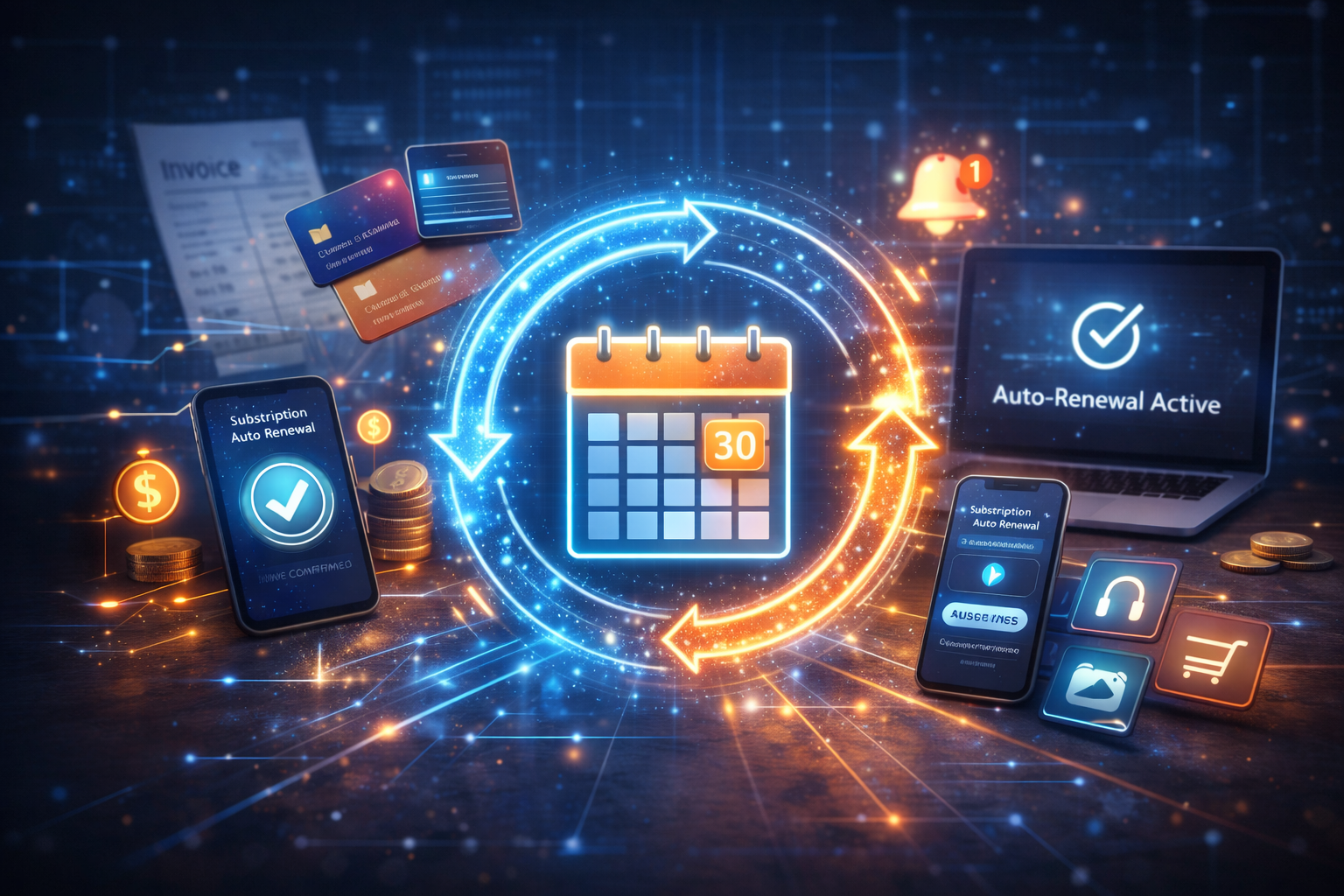
Auto-renewal is a subscription billing mechanism that automatically charges a customer at the end of each billing cycle and extends access to the service.

The system performs several key actions:

  • Detecting the end of a billing period
  • Generating a renewal invoice
  • Charging the stored payment method
  • Updating the subscription status
  • Extending entitlement access

If the payment is successful, the subscription remains active. If the payment fails, the system triggers retry logic or changes the subscription status.

Auto-renewal is designed to maintain continuous service access without requiring the user to manually repurchase the subscription.

Many mobile apps implement recurring subscriptions through in-app purchase subscriptions, which rely on platform billing infrastructure.


Where Users Encounter Auto-Renewal

Auto-renewal is used across many types of digital platforms.

Common examples include:

  • Streaming subscriptions
  • SaaS productivity software
  • Cloud infrastructure platforms
  • Mobile app subscriptions
  • Online learning platforms
  • Membership websites

For example, when users subscribe to a monthly streaming service, the platform automatically charges their payment method every month. As long as the renewal payment succeeds, the subscription continues without interruption.

Major payment platforms such as Stripe provide documentation explaining automated subscription billing systems:

https://docs.stripe.com/billing/subscriptions/overview

What Auto-Renewal Is

Precise Definition

Auto-renewal is a billing system feature that automatically extends a subscription period after the current billing cycle ends.

The renewal process includes:

  1. Detecting the upcoming billing date
  2. Generating a new billing invoice
  3. Charging the stored payment method
  4. Updating subscription metadata
  5. Extending service access

The system executes these steps automatically according to the defined billing interval.


Boundaries of Scope

Auto-renewal does not include:

  • One-time purchases
  • Manual subscription renewals
  • Usage-based billing without recurring periods
  • Lifetime access purchases

Auto-renewal specifically applies to time-based subscription billing models where access must be renewed periodically.


What Problem Auto-Renewal Solves

Auto-renewal exists because subscription services operate continuously over time.

Without auto-renewal systems:

  • Users would need to manually repurchase subscriptions every billing cycle.
  • Platforms would experience frequent service interruptions.
  • Billing systems would require manual confirmation for every payment.

Auto-renewal solves several operational problems:

  • Maintaining uninterrupted service access
  • Simplifying billing operations
  • Reducing manual payment interactions
  • Supporting predictable recurring revenue models

For digital platforms, auto-renewal ensures that subscription access and billing cycles remain synchronized.

If subscription changes occur before a renewal date, billing systems may apply prorated adjustments. These adjustments are described in what is proration in billing .


How Auto-Renewal Works (Step-by-Step)

Understanding how auto-renewal works requires examining the internal subscription lifecycle.


Step 1: Subscription Creation

The process begins when a user subscribes to a service.

During signup, the system stores:

  • customer ID
  • subscription ID
  • billing interval (monthly, yearly, etc.)
  • next billing date
  • payment method token

The billing interval determines when auto-renewal will occur.


Step 2: Billing Cycle Monitoring

The system continuously monitors subscription records.

A background job or billing scheduler checks:

current_time >= next_billing_date

When the billing date arrives, the renewal process begins.

Billing schedulers often operate through distributed task systems that process renewal events in batches.


Step 3: Invoice Generation

Before charging the customer, the billing system generates a renewal invoice.

The invoice typically includes:

  • subscription fee
  • applicable taxes
  • discounts or credits
  • usage-based overages (if applicable)

The invoice becomes the financial record for the upcoming billing period.


Step 4: Payment Processing

Once the invoice is generated, the system attempts to charge the stored payment method.

The payment request is sent to the payment processor.

If the transaction is successful:

  • the invoice is marked as paid
  • the subscription period is extended
  • access remains active

Payment processing relies on external payment networks such as credit card systems or digital wallets.

Stripe provides detailed documentation on recurring billing mechanisms:

https://docs.stripe.com/billing

Step 5: Subscription Extension

After a successful payment, the system updates the subscription metadata.

Typical updates include:

  • new billing cycle start date
  • next billing date
  • payment history record
  • renewal confirmation status

The user’s entitlements continue without interruption.


Payment Failure and Retry Logic

Understanding how auto-renewal works also requires examining payment failures.

Payments may fail for several reasons:

  • expired credit cards
  • insufficient funds
  • fraud detection triggers
  • network errors

When a payment fails, the system usually enters a retry phase.

Retry logic may include:

  • multiple payment attempts over several days
  • reminder emails requesting updated payment methods
  • temporary grace periods

If payment retries fail, the subscription status may change to past_due or canceled.


Subscription States in Auto-Renewal Systems

Auto-renewal platforms often manage multiple subscription states.

Subscription StateDescription
ActiveSubscription is valid and auto-renewal is scheduled
TrialingUser is in a free trial period
Past DuePayment attempt failed
CanceledSubscription ended
IncompletePayment method not provided

These states help billing systems determine when auto-renewal should occur.

Relationship Between Auto-Renewal and Other Pricing Systems

Auto-renewal interacts with several other billing mechanisms.

These include:

  • subscription pricing models
  • free trial onboarding periods
  • SaaS pricing tiers
  • usage-based pricing

For example:

Some services begin with a free trial period before the first auto-renewal occurs.

Others combine usage-based pricing with recurring subscription fees.

Platforms with multiple SaaS pricing tiers may apply different renewal charges depending on the user’s selected plan.

Internal references:

  • how free trials work
  • what is usage-based pricing
  • how SaaS pricing tiers work
  • how subscription pricing works

Tradeoffs and Design Constraints

Although auto-renewal simplifies subscription billing, it introduces several operational challenges.


Payment Reliability

Auto-renewal systems depend heavily on payment reliability.

Expired cards or declined payments may disrupt the renewal process.

Platforms must implement retry logic and notification systems to reduce churn caused by payment failures.


Customer Transparency

Many jurisdictions require businesses to clearly disclose auto-renewal terms.

Users must be informed about:

  • billing frequency
  • renewal charges
  • cancellation procedures

Clear communication helps reduce billing disputes.


Billing System Complexity

Recurring billing requires reliable infrastructure.

Auto-renewal systems must manage:

  • millions of subscription records
  • billing schedules
  • tax calculations
  • payment retries
  • subscription state transitions

Even small system errors can impact large numbers of users simultaneously.


Common Misconceptions About How Auto-Renewal Works

Auto-Renewal Means Unlimited Access

Auto-renewal only extends access if payment succeeds.

If payment fails, the subscription may be suspended.


Auto-Renewal Charges Without Notification

Most subscription platforms notify users before renewal dates or provide billing reminders.


Auto-Renewal Cannot Be Cancelled

Users typically retain the ability to cancel subscriptions before the next renewal cycle.


FAQ: How Auto-Renewal Works

What happens if a subscription auto-renewal payment fails?

Most systems initiate retry attempts and notify the user to update payment details. If payment remains unsuccessful, the subscription may enter a suspended or canceled state.


Can users disable auto-renewal?

Yes. Most subscription platforms allow users to cancel before the next billing cycle, preventing the renewal charge.


Do auto-renewal systems charge immediately at midnight?

Billing schedules vary. Some systems process renewals at specific times of day depending on system load and regional billing policies.


Are auto-renewal payments secure?

Auto-renewal payments rely on encrypted payment processing systems that comply with financial security standards.


Billing Cycle Timing and Renewal Scheduling

Understanding how auto-renewal works also requires examining how billing systems schedule renewal events across large numbers of subscriptions. While the concept of auto-renewal appears simple from a user perspective, the underlying infrastructure must handle precise timing and high transaction volumes.

Every subscription contains metadata that defines when the next renewal should occur. This information is stored in subscription records as fields such as:

  • billing interval
  • billing cycle anchor
  • next billing date
  • renewal status

The billing cycle anchor is especially important because it determines the recurring schedule for future renewals. For example, if a user subscribes on the 15th of the month to a monthly plan, the system may set the billing cycle anchor to that specific date. Future renewals then occur on the same day of each billing cycle.

However, large platforms rarely execute renewals at exactly midnight for every subscription. Instead, they often distribute renewal jobs across time windows to reduce system load. This approach helps prevent performance bottlenecks that could occur if thousands or millions of payments were processed simultaneously.

In practice, renewal scheduling systems operate through background task processors. These processors scan subscription databases and identify records where the current time has reached or passed the next billing date. When this condition is detected, the system queues a renewal task that generates an invoice and attempts payment.

A simplified renewal logic check may look like this:

current_time >= next_billing_date

When this condition evaluates as true, the subscription enters the renewal workflow.

Large billing systems often process renewals in batches rather than individually. Batch processing allows platforms to handle large volumes of subscriptions efficiently. It also helps payment processors manage transaction throughput and reduces the likelihood of rate limits or service interruptions.

Another important element of how auto-renewal works is timezone management. Subscription systems must decide which timezone governs billing schedules. Some platforms standardize billing events using Coordinated Universal Time (UTC), while others anchor billing cycles to the user’s regional timezone. Without consistent time management, renewal events could trigger earlier or later than expected, leading to billing disputes.

Platforms must also consider edge cases such as:

  • months with different numbers of days
  • daylight saving time changes
  • leap years
  • delayed background jobs

For example, if a user subscribes on January 31st to a monthly plan, the system must determine how renewals behave in shorter months such as February. Some billing systems automatically shift renewal dates to the final day of the month, while others adjust the billing cycle anchor permanently.

Auto-renewal scheduling also interacts with payment processor limits and fraud detection systems. When many transactions are processed simultaneously, payment gateways may temporarily flag large volumes of similar charges. To avoid triggering security mechanisms, some subscription platforms stagger renewal attempts across several hours or even multiple days.

In addition, renewal systems must remain resilient to temporary outages. If a billing job fails or the payment processor becomes unavailable, the system must retry the renewal attempt once services are restored. This ensures that temporary infrastructure problems do not permanently disrupt subscriptions.

Because of these operational challenges, large subscription platforms invest heavily in reliable scheduling infrastructure. Renewal schedulers, job queues, and background workers coordinate to ensure that billing events occur accurately and consistently across millions of users.

When analyzing how auto-renewal works at scale, the key takeaway is that renewal timing is not simply a single payment trigger. It is part of a distributed scheduling system that continuously monitors subscription records, generates billing events, and processes payments across the entire platform.

Conclusion

Understanding how auto-renewal works is essential for analyzing subscription-based pricing systems. Auto-renewal enables digital platforms to extend subscription access automatically while maintaining synchronized billing cycles.

The system relies on coordinated processes including billing schedules, invoice generation, payment processing, and subscription state management. When implemented correctly, auto-renewal ensures uninterrupted service access while reducing manual billing interactions.

Within modern digital platforms, auto-renewal is a foundational component of subscription pricing systems and plays a critical role in maintaining stable recurring revenue models.


How VPNs Work: Understanding Virtual Private Networks and Encrypted Internet Tunnels

How VPNs work explained step by step: learn how VPN tunnels, encryption, IP masking, and secure routing protect data and privacy on the internet.

How VPNs work is a fundamental concept in digital infrastructure and internet security. A Virtual Private Network (VPN) allows devices to create encrypted connections across public networks, enabling secure communication between users and remote servers.

Instead of sending internet traffic directly to its destination, a VPN routes traffic through an encrypted tunnel to a VPN server. The server then forwards the request to the internet on behalf of the user. This process hides the user’s original IP address and protects the transmitted data from interception.

Understanding how VPNs work requires examining network routing, encryption protocols, authentication processes, and packet forwarding behavior. VPNs are widely used for secure remote access, privacy protection, and corporate network connectivity.

These mechanisms operate within the broader architecture that explains how the internet works, including routing, DNS resolution, and network communication protocols.


Clear System Definition

A VPN is a networking system that creates a secure connection between a device and a remote server through an encrypted communication channel.

The system performs several core functions:

  • Encrypting data before transmission
  • Routing traffic through a secure tunnel
  • Masking the user’s original IP address
  • Authenticating the connection
  • Forwarding packets to the destination server

When analyzing how VPNs work, the key concept is the creation of a secure tunnel over an insecure network, typically the public internet.


Where You Encounter VPN Technology

VPNs are used across many digital environments.

Common use cases include:

  • Remote work connections to company networks
  • Privacy protection on public Wi-Fi
  • Secure communication between office locations
  • Accessing geographically restricted services
  • Protecting sensitive business communications

For example, many organizations use VPN systems to allow employees to access internal resources remotely. Instead of exposing internal infrastructure directly to the internet, the company requires users to authenticate through a VPN gateway.

The U.S. Cybersecurity and Infrastructure Security Agency provides an overview of VPN technology and its security implications:

https://www.cisa.gov/resources-tools/resources/virtual-private-networks-vpns

What It Is

Precise Definition

A Virtual Private Network is a system that establishes an encrypted communication tunnel between a client device and a remote server across an untrusted network.

This tunnel ensures that:

  • Data remains confidential
  • Network traffic cannot easily be inspected
  • The user’s real network identity is masked

In practice, VPN technology combines multiple components:

  • Encryption protocols
  • Authentication systems
  • Packet encapsulation
  • Secure routing mechanisms

Boundaries of Scope

A VPN does not:

  • Replace internet connectivity
  • Guarantee complete anonymity
  • Prevent all forms of tracking
  • Protect against malware or phishing attacks

Instead, a VPN primarily protects data in transit by encrypting communication between the device and the VPN server.


What Problem VPNs Solve

The public internet was originally designed without strong built-in encryption. Data transmitted across networks can potentially be intercepted by malicious actors, especially when using open Wi-Fi networks or untrusted infrastructure.

VPN systems solve several problems:

  • Protecting data from interception
  • Preventing network surveillance
  • Securing remote access to internal systems
  • Masking a user’s real network location

Without encryption, internet traffic may be visible to:

  • Internet service providers
  • Network administrators
  • Malicious actors performing packet interception

VPN technology helps reduce these risks by encrypting the communication channel.


How VPNs Work (Step-by-Step)

Understanding how VPNs work requires examining the technical sequence that occurs when a user connects to a VPN.


Step 1: VPN Client Initiates Connection

The process begins when a user activates a VPN application on their device.

The VPN client software:

  • Contacts the VPN server
  • Negotiates connection parameters
  • Initiates authentication procedures

Authentication methods may include:

  • Username and password
  • Certificates
  • Multi-factor authentication

Once authentication is successful, the system begins establishing the encrypted tunnel.


Step 2: Encryption Keys Are Negotiated

Before data can be transmitted securely, the client and server must agree on encryption parameters.

This typically involves:

  • Key exchange algorithms
  • Encryption protocol negotiation
  • Session key generation

Common encryption algorithms include:

  • AES-256
  • ChaCha20

These algorithms ensure that intercepted data cannot be easily decrypted.

The National Institute of Standards and Technology provides guidance on encryption standards:

https://csrc.nist.gov/publications/detail/sp/800-175b/final

Step 3: VPN Tunnel Is Established

Once encryption parameters are negotiated, the VPN creates a tunnel.

A tunnel is a virtual pathway where:

  • Data packets are encapsulated
  • Encryption protects the packet contents
  • The destination appears to be the VPN server

Encapsulation means the original data packet is wrapped inside another packet before transmission.

This process hides the original packet information from intermediate networks.


Step 4: Traffic Is Routed Through the VPN Server

After the tunnel is established, all network traffic flows through the VPN server.

Instead of contacting websites directly, the process becomes:

User Device → VPN Server → Internet Destination

When the destination server responds, the path reverses:

Internet Server → VPN Server → User Device

This routing process ensures that the user’s original IP address is hidden.


Step 5: IP Address Masking Occurs

When traffic exits the VPN server and reaches the internet, it appears to originate from the server’s IP address instead of the user’s.

This process is known as IP masking.

The website being accessed sees:

  • The VPN server location
  • The VPN server IP address

It does not directly see the user’s local IP address.


VPN Protocols

VPN systems rely on specific communication protocols that define how encryption and tunneling operate.

Common VPN protocols include:

OpenVPN

OpenVPN is widely used because it is open source and highly configurable. It supports strong encryption and works across multiple operating systems.

WireGuard

WireGuard is a modern VPN protocol designed for speed and simplicity. It uses advanced cryptographic techniques while maintaining a smaller code base.

IPSec

IPSec operates at the network layer and is commonly used for enterprise VPN deployments.

Each protocol defines how VPNs work in terms of:

  • Encryption strength
  • Connection speed
  • Compatibility with network environments

More technical documentation about VPN protocols can be found at the Internet Engineering Task Force:

https://www.ietf.org/process

Tradeoffs and Design Constraints

Although VPN technology improves security and privacy, it also introduces certain tradeoffs.

Reduced Network Speed

Because data must be encrypted and routed through an additional server, VPN connections may reduce network performance.

Trust in VPN Providers

While VPNs hide traffic from local networks, the VPN provider itself can technically observe user traffic if logs are kept.

Server Location Dependency

The geographic location of the VPN server affects latency and connection speed.


Common Misconceptions About How VPNs Work

Several misunderstandings exist about VPN technology.

VPNs Provide Complete Anonymity

VPNs mask IP addresses but do not automatically anonymize user activity across websites.

VPNs Encrypt All Internet Traffic Everywhere

VPNs only encrypt traffic between the device and the VPN server.

After traffic leaves the VPN server, normal internet routing applies.

VPNs Prevent All Tracking

Websites can still track users through cookies, accounts, or browser fingerprinting.


How VPNs Connect to Other Internet Systems

VPN technology interacts with several other components of internet infrastructure.

These include:

  • DNS resolution systems
  • Internet routing protocols
  • Authentication systems
  • Encryption frameworks

For example, when a VPN user visits a website, the system still relies on Domain Name System (DNS) infrastructure to translate domain names into IP addresses.

Internal link suggestion:
what is DNS and how it works

Understanding how VPNs work also benefits from understanding the broader architecture of the internet.

Internal link suggestion:
how the internet works


What This Article Does NOT Cover

This article does not cover:

  • VPN provider comparisons
  • Marketing claims about VPN services
  • Legal implications of VPN usage
  • Circumventing regional restrictions

The focus is strictly on the technical mechanisms that explain how VPNs work.


Glossary

VPN Tunnel
An encrypted communication path between a device and a VPN server.

Encryption
A process that converts readable data into encoded information.

IP Address
A numerical identifier assigned to devices connected to a network.

Encapsulation
Wrapping one network packet inside another packet for transmission.

Authentication
Verifying the identity of a user or device before granting access.


Structured Summary

How VPNs work can be summarized as a process where a client device establishes an encrypted tunnel to a remote VPN server. The VPN server acts as an intermediary between the user and the internet, routing traffic while masking the user’s original IP address.

The system involves multiple components including authentication mechanisms, encryption protocols, packet encapsulation, and routing infrastructure. While VPNs improve privacy and security, they do not replace other security mechanisms and should be understood as one component of a broader digital infrastructure system.

Network Routing and Packet Flow in VPN Connections

Understanding how VPNs work also requires examining how data packets move across networks once the VPN tunnel is established. While the encryption process protects the data itself, the routing behavior determines how that data travels between the user and the destination server.

When a VPN connection is active, the device modifies its routing table so that most or all outgoing network traffic is directed toward the VPN tunnel instead of the normal internet gateway. This means the operating system treats the VPN connection as the primary route for internet communication.

Without a VPN, a typical packet path looks like this:

User Device → Local Router → Internet Service Provider → Destination Server

With a VPN active, the routing path changes:

User Device → Encrypted VPN Tunnel → VPN Server → Destination Server

This routing modification is essential to understanding how VPNs work because it ensures that all transmitted packets are protected before leaving the user’s device.

Packet Encapsulation in VPN Tunnels

Another important component in how VPNs work is packet encapsulation.

Encapsulation means that the original data packet is wrapped inside another packet before it is transmitted across the network. The outer packet contains routing information that directs the traffic to the VPN server rather than directly to the destination website.

The process generally follows these steps:

  1. The user’s device creates the original data packet.
  2. The VPN client encrypts the packet contents.
  3. The encrypted packet is encapsulated within a new packet.
  4. The outer packet is sent to the VPN server.
  5. The VPN server removes the outer wrapper and forwards the original request to the internet.

This layered packet structure is sometimes described as tunneling, because the original traffic travels inside a protected pathway until it reaches the VPN server.

Encapsulation ensures that intermediate networks cannot read the original packet information. Even if the traffic is intercepted, only the encrypted outer packet can be observed.


Split Tunneling vs Full Tunneling

Another concept that helps explain how VPNs work is the difference between split tunneling and full tunneling.

Full Tunnel VPN

In a full tunnel configuration, all internet traffic passes through the VPN. Every request made by the device is encrypted and routed through the VPN server.

This provides the highest level of privacy because the user’s internet service provider cannot see which websites are being accessed.

However, full tunneling may introduce higher latency because every request must travel through the VPN infrastructure before reaching the destination.


Split Tunnel VPN

In split tunneling, only certain traffic is routed through the VPN tunnel.

For example:

  • Corporate application traffic goes through the VPN
  • Normal web browsing uses the regular internet connection

Split tunneling reduces network load and improves speed, but it introduces additional security considerations. If sensitive traffic accidentally bypasses the VPN, it may become visible to external networks.

Understanding these routing decisions is an important part of understanding how VPNs work in real-world deployments.


DNS Handling in VPN Connections

When analyzing how VPNs work, DNS handling becomes another important factor.

DNS (Domain Name System) translates domain names into IP addresses so devices can locate servers on the internet.

Without a VPN, DNS requests typically travel to the DNS server configured by the user’s internet service provider. However, when a VPN is active, DNS requests may be routed through the VPN tunnel instead.

This prevents the ISP from seeing which domain names the user is resolving.

Some VPN systems provide their own DNS servers to avoid DNS leaks, which occur when DNS requests bypass the VPN tunnel and expose browsing activity.

Proper DNS routing ensures that both the content of the traffic and the domain lookup requests remain protected.


How VPN Protocols Compare

Different VPN systems rely on different protocols to create secure tunnels. These protocols determine how VPNs work in terms of encryption strength, connection stability, and overall network performance.

The table below summarizes the most commonly used VPN protocols and how they affect VPN connections.

VPN ProtocolEncryption StrengthSpeedTypical Use Case
OpenVPNVery strong (AES-256)ModerateWidely used commercial VPN services
WireGuardVery strong (modern cryptography)Very fastModern VPN systems and mobile devices
IPSec/IKEv2StrongFastEnterprise VPN connections and mobile networks
L2TP/IPSecModerateSlowerOlder VPN deployments
PPTPWeak (deprecated)FastLegacy systems only

Each protocol influences how VPNs work internally. For example, WireGuard uses a smaller codebase and newer cryptographic primitives, which can improve performance and reduce complexity compared to older protocols.

Organizations often select protocols based on the balance between security requirements and network performance.

For more technical information about encryption protocols, the Internet Engineering Task Force maintains documentation on network standards:

FAQ: How VPNs Work

What does a VPN actually do?

A VPN creates an encrypted tunnel between a device and a remote server. All internet traffic is routed through this tunnel before reaching the destination server. This process protects data in transit and masks the user’s real IP address.

Understanding how VPNs work requires examining encryption, packet encapsulation, and network routing.


Do VPNs hide your IP address?

Yes, a VPN hides the user’s original IP address from websites and services. When traffic exits the VPN server, the destination website sees the IP address of the VPN server instead of the user’s local network address.

However, this does not guarantee complete anonymity because websites can still track users through accounts, cookies, or browser fingerprints.


Does a VPN encrypt all internet traffic?

A VPN encrypts traffic between the user’s device and the VPN server. Once the traffic leaves the VPN server and travels to the destination website, the data is no longer protected by the VPN tunnel itself.

Many websites still use HTTPS encryption, which adds another layer of protection beyond the VPN connection.


Why do VPNs sometimes slow down internet speed?

VPN connections may introduce additional latency because traffic must travel through the VPN server before reaching its destination. Encryption and decryption processes also require additional computing resources.

The performance impact depends on factors such as:

  • Server location
  • Network congestion
  • Encryption protocol
  • Hardware performance

Are VPNs legal to use?

In most countries, VPN technology is legal and commonly used for secure communications, corporate remote access, and privacy protection.

However, some jurisdictions restrict or regulate VPN usage. Users should always verify local regulations before using VPN services.

VPN Server Exit Nodes

A final component of how VPNs work is the concept of exit nodes.

The VPN server acts as the exit point where encrypted traffic leaves the secure tunnel and enters the open internet.

At this stage:

  • The VPN server decrypts the traffic.
  • The original request is forwarded to the destination server.
  • The destination server responds to the VPN server.
  • The response is encrypted again before being sent back through the tunnel.

Because the destination server only sees the VPN server’s IP address, the user’s real location remains hidden.

However, this also means that the VPN provider temporarily acts as an intermediary for the user’s traffic. For this reason, VPN architecture requires trust in the server infrastructure that handles the exit traffic.

Conclusion: How VPNs Work in Modern Internet Infrastructure

Understanding how VPNs work requires looking beyond the simple idea of “hiding your IP address.” A VPN is a networking system that creates an encrypted tunnel between a user’s device and a remote server, allowing data to travel securely across public networks.

When a VPN connection is established, traffic is encrypted, encapsulated into secure packets, and routed through a VPN server before reaching the internet. This process protects data in transit, masks the user’s original IP address, and allows secure communication across untrusted networks.

Several components make this possible. Encryption protocols protect the confidentiality of data, authentication mechanisms verify the identity of the user and server, and tunneling technologies encapsulate network packets so they can travel securely through the internet. These components work together to form a secure communication pathway that shields traffic from interception.

However, VPN technology is not a universal security solution. While it protects data between the device and the VPN server, other factors—such as website security, browser tracking, and device vulnerabilities—still influence overall privacy and security. Understanding how VPNs work helps clarify both the benefits and the limitations of the technology.

In modern digital infrastructure, VPNs play an important role in enabling secure remote access, protecting users on public networks, and allowing organizations to connect distributed systems safely. By combining encryption, authentication, and network routing techniques, VPNs provide a practical way to secure internet communication in environments where the underlying network cannot be fully trusted.

How Authentication Tokens Work

Understanding how authentication tokens work is essential to understanding modern digital identity systems. Nearly every web application, API platform, and mobile service depends on authentication tokens to maintain login state after initial credential verification.

When a user logs in, they provide credentials such as a password or multi-factor code. However, systems do not ask for credentials on every request. Instead, they issue a token — a structured credential that represents authenticated identity. To understand how authentication tokens work, we must examine the full lifecycle: issuance, transmission, validation, expiration, and revocation.

Authentication tokens exist because identity verification and resource access are two separate system problems. This article explains how authentication tokens work from a system architecture perspective, focusing strictly on mechanisms, validation logic, and security constraints.

How authentication tokens work within “How Online Logins Work (Sessions, Cookies, Tokens, and SSO)”


Clear System Definition

An authentication token is a time-bound credential issued after successful identity verification. It allows a system to confirm that a request originates from a previously authenticated user without reprocessing credentials.

Understanding how authentication tokens work requires distinguishing them from:

  • Passwords
  • Sessions
  • API keys
  • Authorization policies

Tokens are identity representations — not identity proof mechanisms themselves.


Where Readers Encounter How Authentication Tokens Work in Real Life

You encounter authentication tokens when:

  • Staying logged into a web application
  • Using a mobile banking app
  • Calling APIs with an Authorization header
  • Accessing SaaS dashboards
  • Using OAuth-based login flows
  • Accessing microservices within cloud infrastructure

Whenever you reload a page and remain logged in, authentication tokens are being validated behind the scenes.

Session cookies and authentication tokens are related but distinct; see What Is a Session Cookie for context.


What It Is

Precise Definition

Authentication tokens are cryptographically verifiable credentials that assert an authenticated identity for a defined duration.

They typically include:

  • Subject identifier (user ID)
  • Issuer identifier
  • Expiration timestamp
  • Optional claims (roles, scopes)
  • Digital signature or reference ID

Boundaries of Scope

Authentication tokens:

  • Represent authenticated state
  • Enable request validation
  • Reduce repeated credential submission

Authentication tokens do NOT:

  • Authenticate users independently
  • Replace authorization logic
  • Store plaintext passwords
  • Guarantee permanent access

Understanding how authentication tokens work requires seeing them as temporary identity containers.


What Problem It Solves

Before tokens, systems relied heavily on server-side sessions. That approach created limitations:

  • Memory usage per active user
  • Load balancing challenges
  • Session synchronization issues
  • Scaling bottlenecks

How authentication tokens work solves these problems by:

  1. Allowing stateless validation
  2. Reducing server-side session dependency
  3. Supporting distributed architectures
  4. Enabling cross-service identity validation

Tokens decouple authentication from resource delivery.


Why Authentication Tokens Exist in Modern Architecture

Modern systems are:

  • Distributed
  • Horizontally scalable
  • API-driven
  • Multi-device

In such systems, centralized session storage becomes restrictive.

Authentication tokens emerged to:

  • Allow services to validate identity independently
  • Avoid database lookups on every request
  • Enable federated identity across systems
  • Support cloud-native architectures

Understanding how authentication tokens work requires understanding distributed systems constraints.


How Authentication Tokens Work (Step-by-Step Lifecycle)

Step 1: Identity Verification

The user submits credentials.

The authentication server:

  • Validates password or MFA
  • Applies rate limiting
  • Verifies account status

Only after successful verification does token issuance begin.


Step 2: Token Construction

The server creates a token payload including:

  • User ID
  • Issuer
  • Expiration
  • Optional permissions

The payload is then:

  • Signed cryptographically (self-contained token), or
  • Stored server-side with a generated reference ID (opaque token)

Step 3: Token Delivery

The token is returned to the client via:

  • HTTP response body
  • Secure cookie
  • Authorization header
  • Mobile secure storage API

Transmission must occur over encrypted connections.

For secure communication reference:
DoFollow resource:
https://www.rfc-editor.org/rfc/rfc6750 (OAuth Bearer Token Usage)


Step 4: Token Storage on Client

The client stores the token:

  • Browser memory
  • HttpOnly cookie
  • Secure enclave (mobile)
  • Temporary storage

Improper storage increases risk of token theft.


Step 5: Token Transmission with Each Request

Every protected request includes the token.

Example structure:

Authorization: Bearer {token}

The resource server extracts and validates it.


Step 6: Token Validation Logic

To understand how authentication tokens work in APIs, validation is critical.

The server checks:

  1. Signature integrity
  2. Expiration timestamp
  3. Issuer authenticity
  4. Claim integrity
  5. Optional revocation list

If validation fails, access is denied.

If valid, authentication succeeds.


Step 7: Authorization Layer

Authentication ≠ authorization.

After token validation:

  • Role checks occur
  • Resource permissions enforced
  • Access control logic applied

Internal link suggestion:
Link to your article:
→ How Online Logins Work (Sessions, Cookies, Tokens, and SSO)


Step 8: Expiration and Renewal

Tokens expire.

Expiration:

  • Limits exposure window
  • Reduces replay attack risk
  • Forces periodic re-authentication

Some systems use refresh tokens to issue new access tokens.


How Authentication Tokens Work in Distributed Systems

In distributed architectures:

  • Microservices receive tokens
  • Each service validates independently
  • No central session lookup required

This supports horizontal scaling.

However, revocation becomes more complex.


Types of Authentication Tokens

Opaque Tokens

  • Random reference ID
  • Server lookup required

Advantages:

  • Easy revocation
  • Central control

Disadvantages:

  • Database dependency

Self-Contained Tokens

Often structured as signed tokens.

Advantages:

  • Stateless validation
  • High scalability

Disadvantages:

  • Harder immediate revocation
  • Larger payload size

For specification reference (DoFollow):
https://datatracker.ietf.org/doc/html/rfc7519


Access Tokens vs Refresh Tokens

Access tokens:

  • Short-lived
  • Used for resource access

Refresh tokens:

  • Longer-lived
  • Used to obtain new access tokens

Understanding how authentication tokens work requires understanding this dual-token model.


Tradeoffs in How Authentication Tokens Work

Security vs Usability

Long expiration:

  • Better user experience
  • Increased attack window

Short expiration:

  • Safer
  • More refresh cycles

Stateless vs Stateful Validation

Stateless:

  • No DB lookup
  • Harder revocation

Stateful:

  • Central control
  • Requires synchronization

Payload Design

Embedding too much information:

  • Reduces flexibility
  • Complicates role updates
  • Creates policy rigidity

Risks and Failure Modes

Token Theft

Causes:

  • XSS
  • Insecure storage
  • Browser extension leaks

Mitigation:

  • HttpOnly cookies
  • Short expiration
  • Rotation strategies

Replay Attacks

Mitigated by:

  • HTTPS
  • Expiration
  • Device binding
  • Nonce strategies

Signing Key Exposure

If signing keys leak:

  • All issued tokens become suspect
  • Immediate key rotation required

Common Misconceptions About How Authentication Tokens Work

“Tokens Replace Sessions”

False.
Some systems use hybrid models.


“Tokens Are Encrypted”

False.
Most are signed, not encrypted.


“JWT Equals Authentication”

False.
JWT is a format. Authentication is a process.


“Tokens Remove Need for Authorization”

False.
Authorization policies still required.


How Authentication Tokens Work with Other Identity Systems

They integrate with:

  • Session management
  • Cookies
  • OAuth
  • Single sign-on
  • Multi-factor authentication
  • Identity systems

Internal link suggestions:

→ what is OAuth
→ what is single sign-on
→ what is multi-factor authentication

Keep these as contextual links inside body paragraphs.


What This Article Does NOT Cover

This article does not:

  • Explain credential hashing algorithms
  • Provide cryptographic math tutorials
  • Cover OAuth grant flows in depth
  • Explain browser networking internals
  • Discuss pricing systems
  • Provide implementation code

Short Glossary

Authentication – Identity verification process.
Token – Credential representing authenticated identity.
Claim – Information asserted inside a token.
Signature – Cryptographic integrity proof.
Access Token – Short-lived resource access credential.
Refresh Token – Credential used to obtain new access tokens.
Revocation – Early invalidation of tokens.
Stateless Validation – Verification without server lookup.


Structured Summary

Understanding how authentication tokens work requires separating authentication from session persistence. Tokens are issued after identity verification and serve as portable, time-bound identity credentials.

They allow distributed systems to validate identity without centralized session storage. Their lifecycle includes issuance, transmission, validation, expiration, and potential revocation.

Design tradeoffs involve security, scalability, storage, and revocation complexity. Authentication tokens do not replace authorization, encryption, or identity systems — they operate within them as structured identity representations.

https://datatracker.ietf.org/doc/html/rfc7519

https://www.rfc-editor.org/rfc/rfc6750

How free trials work

How free trials work in subscription systems: understand trial states, billing handoff, entitlement control, payment retries, and lifecycle transitions in digital billing architectures.

How free trials work is often explained as “temporary free access before payment begins.” From a systems perspective, this description is incomplete. A free trial is not simply free usage — it is a controlled billing state inside a subscription system with deterministic time boundaries, entitlement rules, and a scheduled billing transition.

Understanding how free trials work requires examining subscription objects, billing lifecycle transitions, payment authorization logic, entitlement enforcement, time precision constraints, and failure handling. The complexity lies not in granting access, but in managing the handoff from non-billable state to billable state without financial inconsistency, entitlement ambiguity, or revenue leakage.

In modern digital systems, free trials are tightly integrated with subscription engines, identity layers, invoice generators, and payment processors. They are lifecycle phases, not promotional add-ons. This article explains how free trials work as a system mechanism inside digital billing architectures.

To understand the broader context in which trial states exist, it helps to examine how subscription pricing works at a system level.


Clear System Definition

A free trial is a time-bound subscription state that:

  • Grants temporary entitlements
  • Defers billing
  • Schedules a future billing event
  • Defines deterministic transition rules
  • Preserves billing context for later activation

It operates inside the broader subscription lifecycle and must integrate with:

  • Authentication systems
  • Entitlement systems
  • Billing logic engines
  • Payment processing infrastructure
  • Access control mechanisms
  • Time and scheduling services

A free trial is not an absence of billing logic. It is a delayed billing state governed by predefined transition conditions.


Where Users Encounter Free Trials

Users encounter free trials in:

  • SaaS subscription platforms
  • Streaming services
  • Developer tools
  • API-based platforms
  • Cloud infrastructure dashboards
  • Productivity applications
  • Enterprise software procurement flows

In many SaaS products, trial access reflects the structure of defined pricing tiers that later determine billing and entitlements.

In each case, the system must manage the same structural problem:

Provide temporary entitlement access while preparing a deterministic billing activation event.

The external user experience may differ, but the internal mechanics follow similar architectural patterns.


What It Is

Precise Definition

A free trial is a structured subscription lifecycle phase in which:

  • subscription_status = trialing
  • charges = deferred
  • entitlements = temporarily active
  • billing_activation = scheduled

It is not a separate pricing model.
It is a controlled pre-billing state inside a subscription model.

The defining property of how free trials work is that billing activation is predetermined, not manually triggered. The system schedules a transition event at trial creation time.


Boundaries of Scope

This article does not include:

  • Freemium (permanent free tiers with no billing transition)
  • One-time promotional credits
  • Demo environments without subscription objects
  • Marketing strategy for conversion
  • Behavioral experimentation

This article strictly explains how free trials work inside billing systems.


What Problem Free Trials Solve

From a systems perspective, free trials solve:

  • Controlled temporary access before payment
  • Deferred payment authorization
  • Subscription initialization without immediate settlement
  • Reduced onboarding friction while preserving billing structure

The key technical challenge is:

Scheduling a predictable billing handoff while maintaining entitlement correctness and financial integrity.

Free trials allow a system to initialize the full subscription context early — including plan, billing interval, and pricing rules — while deferring charge execution.


How Free Trials Work in Subscription Billing Systems

This section explains step-by-step how free trials work operationally.


Step 1: Account Creation and Identity Binding

A trial begins when:

  • A user creates an account
  • Authentication credentials are established
  • A subscription object is created

The system creates structured records:

  • user_id
  • subscription_id
  • plan_id
  • status = trialing
  • trial_start_timestamp
  • trial_end_timestamp
  • billing_cycle_anchor
  • currency
  • pricing_version

Identity binding is critical because how free trials work depends on associating a single trial period with a unique account or entity. Systems may enforce:

  • One trial per email
  • One trial per payment method
  • One trial per organization
  • Device-based restrictions

Without identity constraints, trial abuse becomes a systemic risk.

In many subscription platforms, this transition activates the auto-renewal billing system that continues charging the subscription at regular intervals.


Step 2: Trial State Initialization

When status = trialing:

  • No invoice is generated
  • No subscription charge is applied
  • Billing cycle countdown begins
  • Entitlements activate under trial rules

The subscription record must define:

  • Trial duration
  • Exact expiration timestamp
  • Billing interval after trial
  • Next billing date
  • Plan configuration snapshot

Time boundary precision is critical.

The system must define:

  • Timezone authority (UTC vs regional)
  • Inclusive vs exclusive expiration logic
  • Timestamp rounding behavior
  • Execution timing tolerance

Even small timing inconsistencies can create billing disputes or early suspension errors.


Step 3: Entitlement Activation During Trial

Entitlement systems evaluate subscription state continuously.

Logic pattern:

IF subscription_status == trialing
THEN grant trial entitlements

Trial entitlements may include:

  • Full feature access
  • Limited feature access
  • Usage caps
  • Sandbox-only permissions
  • API rate limits
  • Temporary quota thresholds

How free trials work depends heavily on entitlement mapping accuracy. Entitlements must reflect:

  • Trial limitations
  • Plan characteristics
  • Future paid access expectations

Incorrect entitlement mapping can result in:

  • Overexposure of premium features
  • Unexpected feature removal at conversion
  • Customer confusion during handoff

Step 4: Payment Method Collection

How free trials work depends significantly on when payment credentials are collected.

Model A: Card Required at Signup

  • Card token stored securely
  • Optional authorization pre-check
  • Automatic charge at trial end
  • Billing handoff is automated

Advantages:

  • Predictable conversion flow
  • Lower post-trial friction

Risks:

  • Authorization declines at activation
  • Card expiration before trial end
  • Fraud detection triggers

Model B: Card Required at Trial End

  • Reminder notification sent
  • No automatic charge possible without card
  • Subscription may expire if card not added

Advantages:

  • Lower signup friction
  • Reduced initial abandonment

Risks:

  • Higher drop-off at trial end
  • Manual billing interruption

The chosen model directly affects how free trials work during billing handoff.

Reference documentation:

https://docs.stripe.com/billing/subscriptions/trials

Step 5: Trial Countdown Monitoring

The system continuously evaluates:

current_time >= trial_end_timestamp

If false:

  • Remain in trial state

If true:

  • Trigger billing activation workflow

Monitoring may be implemented via:

  • Scheduled background jobs
  • Event-driven triggers
  • Distributed lifecycle processors
  • Cron-based subscription sweepers

The monitoring service must be resilient to:

  • Delayed job execution
  • Queue backlogs
  • Server restarts
  • Clock synchronization errors

Trial expiration must execute once and only once to avoid duplicate billing attempts.


Step 6: Billing Handoff (Trial → Active)

This is the most critical moment in how free trials work.

When trial ends:

  1. status changes from trialing → active
  2. Invoice object is generated
  3. Billing logic calculates subscription charge
  4. Payment attempt executed
  5. Entitlements updated accordingly

The transition must be atomic. Partial execution may cause:

  • Active subscription without invoice
  • Invoice without status change
  • Entitlement mismatch

Possible outcomes:

Successful Payment

  • Subscription remains active
  • Entitlements continue uninterrupted
  • Next billing cycle scheduled

Failed Payment

  • status = past_due
  • Retry logic initiated
  • Grace period may activate
  • Entitlement downgrade may occur

No Payment Method

  • status = incomplete
  • Access may be suspended
  • Reminder notifications triggered

The billing handoff defines the correctness of the entire free trial system.

This transition mirrors the activation phase described in subscription pricing architectures, where billing state and entitlement state must remain synchronized.


Step 7: Grace Period Handling

Some systems implement controlled grace windows.

Grace handling may include:

  • Retry intervals (e.g., 3 attempts over 7 days)
  • Partial entitlement continuation
  • Gradual feature restriction
  • Hard suspension after threshold

Grace periods require:

  • Retry counters
  • Scheduled payment attempts
  • Deterministic suspension rules
  • Audit logging of attempts

Grace logic must be transparent and consistent to avoid disputes.


Variations in How Free Trials Work

Free trials can be implemented in multiple structural forms.


1. Time-Based Trials

Fixed duration (e.g., 7, 14, 30 days).

Characteristics:

  • Simple time boundary
  • No dependency on usage
  • Straightforward billing activation

Most common implementation.


2. Usage-Capped Trials

Trial ends when:

  • Usage exceeds defined threshold
  • Resource consumption limit reached

This combines free trials with usage-based pricing logic.

This combines free trials with usage-based pricing logic, where consumption is measured and later converted into billable units.

System must track:

  • Metered usage during trial
  • Cap threshold triggers
  • Early billing activation

3. Feature-Limited Trials

Trial entitlements restricted to:

  • Reduced quotas
  • Restricted feature sets
  • Limited API endpoints
  • Sandbox-only environments

Conversion transition may unlock:

  • Expanded quotas
  • Production endpoints
  • Higher rate limits

4. Credit-Based Trials

System grants free credits:

  • Credits deducted via usage metering
  • Trial ends when credit balance reaches zero

This merges prepaid billing logic with trial state.

The system must ensure credit deduction consistency and prevent overdraft.

When the trial period ends in a mobile application, the system may convert the user into a paid subscription through in-app purchase billing systems.


Tradeoffs and Design Constraints

Abuse Prevention

Systems must prevent:

  • Multiple trial registrations
  • Disposable email usage
  • Payment method cycling
  • Device rotation abuse

Controls may include:

  • Email verification
  • Payment fingerprinting
  • Device identification
  • IP rate limiting
  • Account uniqueness constraints

Time Precision Risks

Trials depend on exact time boundaries.

Risks include:

  • Clock drift across distributed systems
  • Daylight savings transitions
  • Leap seconds
  • Server timezone inconsistencies
  • Delayed job execution

Free trials are highly sensitive to timestamp precision.


Payment Failure Complexity

Trial-to-paid transition introduces:

  • Card expiration risk
  • Insufficient funds
  • Fraud detection triggers
  • Authorization declines
  • Network failures during charge attempt

Payment retry logic must be deterministic, logged, and reproducible.


Common Misconceptions About How Free Trials Work

Misconception 1: Trials Are Just “Free Time”

They are subscription states with scheduled billing activation and defined transition rules.


Misconception 2: Trials Require No Billing System

Trials require:

  • Subscription objects
  • Invoice generation
  • Payment processing integration
  • Status transitions
  • Retry workflows

They are billing systems with delayed charging.


Misconception 3: Trial Expiration Is Always Immediate

Some systems:

  • Allow grace windows
  • Delay suspension
  • Retry payment before revoking access

Expiration behavior is configurable and rule-driven.


What This Article Does NOT Cover

This article does not cover:

  • Marketing optimization
  • Conversion strategies
  • Funnel experimentation
  • Behavioral psychology
  • Trial length optimization

It focuses strictly on how free trials work inside billing architectures.


Short Glossary

Trial State — Temporary subscription status before billing activation.
Billing Handoff — Transition from trial to paid subscription.
Grace Period — Post-failure temporary access window.
Entitlement — Access rights granted by subscription state.
Retry Logic — Automated payment reattempt sequence.
Subscription Object — Database record representing billing relationship.
Billing Cycle Anchor — Timestamp defining recurring billing interval start.


Conclusion

How free trials work is best understood as a deterministic subscription lifecycle phase that temporarily activates entitlements while scheduling a billing activation event. The complexity lies not in granting access, but in managing the transition from trialing to active status without financial inconsistency, entitlement ambiguity, duplicate billing, or missed charges.

A free trial is a controlled billing state. It connects identity systems, entitlement enforcement, billing logic, invoice generation, payment processing, and lifecycle monitoring into a scheduled transition workflow. When implemented correctly, it provides temporary access while maintaining structural correctness in digital billing systems.

At a systems level, how free trials work is not about free access. It is about precise state management, deterministic timing, and reliable billing handoff inside subscription architectures.

How TikTok For You Recommendations Work: The Technical Architecture

A complete deep dive into how TikTok For You recommendations work, including personalization systems, user behavior signals, feedback loops, ranking logic, and creator implications.

Why TikTok Recommendations Are Fundamentally Different

TikTok is not just another social platform.
It is one of the most aggressive and efficient recommendation-first systems ever deployed at consumer scale.

Unlike platforms that rely heavily on social graphs, TikTok is built around a single idea:

Content should find its audience faster than users find content.

This philosophy reshapes everything:

  • How videos are distributed
  • How creators grow
  • How trends emerge
  • How quickly personalization occurs

TikTok’s For You page (FYP) is not a feed of people you follow — it is a real-time prediction engine testing what you might want next.

To understand the broader system behind these recommendations, you can explore what a ranking algorithm is and how platforms use signals to decide what content to show.

Many recommendation systems rely on user behavior patterns. Learn more about collaborative filtering and how it shapes content suggestions across platforms.

Recommendation systems evolve based on feedback loops. See how feedback loops influence what you see .


How TikTok For You Recommendations Work: The Core Objective of the TikTok For You System

TikTok does not optimize primarily for:

  • Followers
  • Social relationships
  • Creator loyalty

Instead, it optimizes for:

Immediate and repeated viewer engagement under extreme uncertainty.

This makes TikTok’s system:

  • Faster than YouTube’s
  • More volatile
  • More exploratory
  • More experimental

Understanding this goal explains why TikTok feels addictive, unpredictable, and opportunity-rich.


What the TikTok For You Page Actually Is

The For You page is a ranked stream of short-form video predictions.

Every swipe represents a decision:

  • Should this user see this video right now?
  • Or something else?

TikTok re-evaluates this decision constantly, often after just a few seconds of interaction.

Many large-scale recommendation systems rely on collaborative filtering, a foundational concept in recommender system research. For a deeper academic explanation, see: Resnick & Varian – Recommender Systems (ACM) .

How TikTok For You Recommendations Work: Recommendation-First vs Social-First Platforms

To understand TikTok, it helps to contrast it with social-graph platforms.

Social-First Platforms

  • Content spreads through followers
  • Discovery is slower
  • Reach is gated by relationships

Recommendation-First Platforms (TikTok)

  • Content spreads through behavior
  • Discovery is immediate
  • Reach is earned per impression

TikTok largely ignores who you follow during early distribution.


The Two-Stage Architecture of TikTok Recommendations

Like most large-scale systems, TikTok uses a multi-stage pipeline.


Stage 1: Aggressive Candidate Generation

TikTok pulls candidates from:

  • Fresh uploads
  • Similar viewer behavior clusters
  • Trending audio and formats
  • Geographic and language pools
  • Creator history (lightly)

The goal is coverage, not accuracy.

TikTok wants to test content quickly.


Stage 2: Rapid Ranking and Re-Ranking

Ranking models score videos based on:

  • Predicted watch duration
  • Completion probability
  • Rewatch likelihood
  • Swipe-away risk
  • Session continuation value

Crucially, ranking updates happen fast — sometimes within minutes.

Unlike YouTube’s longer-session optimization strategy, TikTok’s system prioritizes rapid engagement testing. For a deeper comparison, see our analysis of how YouTube recommendations work .

How TikTok For You Recommendations Work: The Most Important Signals in TikTok Recommendations

TikTok relies almost entirely on implicit behavior.

Explicit signals (likes, comments) matter — but behavior dominates.


Watch Time (Compressed)

TikTok tracks:

  • How long the video was watched
  • Whether it was completed
  • Whether it was replayed
  • How fast the swipe occurred

A 7-second watch on a 10-second video is extremely strong.


Completion Rate

Completion rate is one of TikTok’s most powerful signals.

Why?

  • Short videos reduce noise
  • Completion indicates clear interest
  • It correlates strongly with satisfaction

Rewatches

Rewatches are disproportionately valuable.

They suggest:

  • High entertainment density
  • Cognitive or emotional impact
  • Strong alignment with viewer taste

Swipe Behavior (Negative Signal)

Fast swipes signal:

  • Disinterest
  • Mismatch
  • Low hook quality

TikTok learns what not to show just as quickly.


How TikTok For You Recommendations Work: Why Likes and Comments Matter Less Than You Think

Engagement helps — but only if behavior supports it.

A video with:

  • Many likes
  • Poor watch completion

Will stall.

TikTok trusts attention, not applause.


Personalization on TikTok: Shockingly Fast Adaptation

TikTok’s most distinctive feature is how quickly it personalizes.

New users often see accurate recommendations within:

  • 10–30 interactions
  • Sometimes minutes

This speed comes from:

  • Short content
  • Dense feedback
  • Aggressive exploration

User Modeling: How TikTok Represents Viewers

TikTok builds multi-dimensional user profiles, not static interests.

User representations encode:

  • Content themes
  • Visual styles
  • Audio preferences
  • Engagement tempo
  • Swipe tolerance

These representations update constantly.


Item Modeling: How TikTok Understands Videos

Videos are embedded using:

  • Visual features
  • Audio patterns
  • Text overlays
  • Captions and hashtags
  • Early behavioral response

TikTok understands style better than meaning.


How TikTok For You Recommendations Work: The Feedback Loop That Makes TikTok Feel Addictive

TikTok’s system creates tight feedback loops:

  1. Show video
  2. Observe micro-behavior
  3. Update model
  4. Adjust next recommendation

This loop can complete in seconds.

This explains:

  • Rapid trend formation
  • Sudden content pivots
  • Strong habit formation

How TikTok For You Recommendations Work: Exploration vs Exploitation on TikTok: Why Everything Feels Like a Test

TikTok leans far more aggressively toward exploration than most platforms.

Where YouTube cautiously expands distribution, TikTok does the opposite:

  • Test fast
  • Test widely
  • Eliminate quickly
  • Scale explosively

This is why TikTok feels unpredictable.


Why TikTok Prioritizes Exploration

TikTok’s design assumptions are:

  • Most content is disposable
  • Viewer preferences shift rapidly
  • New creators should surface quickly
  • Trends are short-lived

Aggressive exploration allows TikTok to:

  • Discover breakout content early
  • Avoid stagnation
  • Continuously refresh the feed

What Exploitation Looks Like on TikTok

Exploitation happens when:

  • A video repeatedly completes
  • Rewatches occur
  • Swipes slow down
  • Sessions extend

At that point, TikTok begins showing the video to larger but still similar clusters.

Exploitation is earned, not assumed.

How TikTok For You Recommendations Work: Why TikTok Virality Is Fast—and Fragile

TikTok virality is not designed to last.

A viral video typically:

  • Explodes within hours or days
  • Peaks quickly
  • Declines just as fast

This is not a flaw. It is intentional.


Why TikTok Does Not Sustain Viral Content

TikTok prioritizes:

  • Novelty
  • Variety
  • Feed freshness

Sustaining one viral video too long would:

  • Reduce discovery
  • Bore viewers
  • Slow experimentation

Instead, TikTok reallocates attention continuously.


The “One-Hit Wonder” Effect

Many creators experience:

  • One massive viral hit
  • Followed by much lower reach

This happens because:

  • Viral reach often includes misaligned viewers
  • Follow-up videos underperform relative to expectations
  • The system recalibrates quickly

Virality ≠ audience fit.


Creator Growth Phases on TikTok

TikTok creator growth follows recognizable phases.


Phase 1: High Volatility Discovery

Characteristics:

  • Wild view swings
  • Inconsistent audiences
  • Rapid testing

This phase favors experimentation.


Phase 2: Pattern Recognition

TikTok begins learning:

  • Which viewers respond
  • Which formats work
  • Which hooks retain attention

Distribution stabilizes somewhat.


Phase 3: Format Lock-In

Successful creators often:

  • Repeat proven formats
  • Refine hooks
  • Narrow audience targeting

This improves predictability—but risks stagnation.


Phase 4: Plateau or Reinvention

At scale, creators must:

  • Evolve formats carefully
  • Introduce novelty without confusion
  • Avoid audience fatigue

Many creators fail here by changing too abruptly.


How TikTok For You Recommendations Work: Hooks: The Most Overrated and Underrated Concept

Hooks matter—but not for the reasons people think.

TikTok does not measure:

  • How clever a hook is
  • How shocking the first second feels

It measures:

  • Whether viewers stay
  • Whether they rewatch
  • Whether they slow their swipe

A quiet hook that aligns with the right audience can outperform flashy ones.


Hashtags on TikTok: What They Actually Do

Hashtags do not directly cause virality.

Their real function:

  • Provide weak topical signals
  • Help initial categorization
  • Enable minor discovery surfaces

Behavioral signals override hashtags almost immediately.


Why Hashtag Strategies Rarely Work

Once TikTok observes real viewer behavior:

  • Hashtag relevance becomes secondary
  • Watch patterns dominate ranking

Hashtags help the first test, not the outcome.


Sounds and Trends: Pattern Matching, Not Magic

Trending sounds matter—but indirectly.

Sounds help TikTok:

  • Group similar content
  • Test format variants
  • Compare relative performance

Using a sound does not boost a video by default.
Performing well within that sound cluster does.

Shadowbanning on TikTok: The Correct Explanation

“Shadowbanning” is a misleading term.

What creators experience is usually:

  • Rapid test failure
  • Audience mismatch
  • Declining relative performance

TikTok does not need secret suppression.
The ranking system already reallocates attention efficiently.


When Reach Drops Sharply

Common causes:

  • Low completion relative to peers
  • Fast swipe-away behavior
  • Repetitive content fatigue
  • Trend saturation

These are performance outcomes, not penalties.


How TikTok For You Recommendations Work: Why TikTok Feels More Addictive Than Other Platforms

TikTok’s addictiveness comes from:

  • Ultra-short feedback loops
  • Immediate personalization
  • Endless novelty
  • Low cognitive effort per video

Each swipe is a tiny experiment with instant reward or correction.


Monetization Constraints in TikTok Recommendations

While TikTok optimizes for engagement, constraints still exist:

  • Advertiser suitability
  • Safety policies
  • Regional regulations
  • Content moderation systems

Videos violating guidelines may still appear—but with limited reach.


Why TikTok Is Harder to Sustain Long-Term

Compared to YouTube, TikTok:

  • Rewards novelty over depth
  • Penalizes repetition faster
  • Cycles trends aggressively

This makes TikTok excellent for discovery—but challenging for longevity.

Creators who last:

  • Build recognizable styles
  • Maintain format evolution
  • Avoid trend dependency

Strategic Takeaways for TikTok Creators

Creators aligned with TikTok’s system:

  • Think in formats, not videos
  • Optimize for completion, not likes
  • Embrace experimentation
  • Expect volatility
  • Separate virality from growth

Understanding the system reduces frustration.


Mental Model: TikTok as a Real-Time Taste Lab

The most accurate mental model:

TikTok is a massive, continuous taste experiment running in real time.

Every video is a hypothesis.
Every swipe is a data point.
Every trend is a temporary solution.

Long-Term Sustainability on TikTok: Why Most Creators Burn Out

TikTok is exceptional at discovering creators — but much weaker at sustaining them.

This is not accidental.


Why TikTok Rewards Novelty Over Stability

TikTok’s system assumes:

  • Viewer preferences change rapidly
  • Attention is short-lived
  • Feed freshness is critical

As a result:

  • New formats are favored
  • Repetition decays quickly
  • Familiarity becomes a liability over time

Creators who rely on a single format often experience sudden decline.


The “Format Half-Life” Problem

Every TikTok format has a half-life.

Over time:

  • Viewers predict the payoff
  • Completion drops
  • Rewatches decline
  • The system reallocates traffic

Sustainable creators continuously evolve within a recognizable style.


Audience Fragmentation: TikTok Does Not Build One Audience

Unlike subscription-based platforms, TikTok builds many micro-audiences.

A single creator may have:

  • One audience for humor
  • Another for education
  • Another for trends
  • Another for personality

These audiences may barely overlap.


Why This Causes Inconsistent Performance

When a new video:

  • Appeals strongly to one cluster
  • But weakly to others

Overall performance appears erratic.

This is normal behavior in a cluster-based system.


Why “Followers” Are a Weak Signal

Followers:

  • Increase initial test probability slightly
  • Do not guarantee distribution
  • Do not unify audience interests

TikTok trusts behavioral alignment, not declared intent.


How TikTok For You Recommendations Work: Audience Clusters and Content Buckets

Internally, TikTok groups viewers into clusters based on:

  • Content themes
  • Viewing tempo
  • Engagement intensity
  • Format preference

Videos are tested within clusters, not globally.

Success in one cluster does not imply success in another.

How TikTok For You Recommendations Work: Why Cross-Posting Strategies Often Fail

Many creators cross-post from TikTok to other platforms (and vice versa) expecting similar results.

This often fails because:

  • Viewer intent differs
  • Consumption speed differs
  • Feedback loops differ
  • Session structure differs

Content is not portable without adaptation.


TikTok ↔ YouTube Shorts Myth

Shorts and TikToks look similar, but:

  • TikTok favors immediacy
  • YouTube favors session contribution
  • TikTok explores faster
  • YouTube stabilizes longer

Success on one does not guarantee success on the other.


Why TikTok Is Less Predictable Than YouTube (By Design)

TikTok optimizes for:

  • Discovery
  • Experimentation
  • Trend velocity

YouTube optimizes for:

  • Satisfaction
  • Retention
  • Long-term value

Predictability emerges from stability — which TikTok intentionally sacrifices.


Regulation, Geopolitics, and System Constraints

TikTok’s recommendation system operates under unique pressures:

  • Regional laws
  • Content moderation requirements
  • Political scrutiny
  • Data governance constraints

These pressures affect:

  • Distribution patterns
  • Topic sensitivity
  • Regional recommendation differences

This is why behavior varies by country.


Content Moderation and Soft Constraints

Not all moderation is binary.

Soft constraints include:

  • Reduced exploration
  • Smaller test pools
  • Slower distribution
  • Limited resurfacing

These constraints shape outcomes without outright removal.

How TikTok For You Recommendations Work: Why TikTok Creators Often Misread Analytics

TikTok analytics lag behind system behavior.

Creators see:

  • Views
  • Likes
  • Shares

The system sees:

  • Micro-retention curves
  • Swipe velocity
  • Cluster-level satisfaction
  • Comparative performance

This mismatch fuels confusion.


Advanced Failure Modes on TikTok

Understanding failure modes prevents misinterpretation.


Failure Mode 1: Overfitting to Trends

Chasing every trend:

  • Dilutes audience signal
  • Reduces predictability
  • Increases volatility

Failure Mode 2: Format Exhaustion

Repeating a winning format too long:

  • Lowers completion
  • Signals fatigue
  • Triggers distribution decay

Failure Mode 3: Broad Appeal Confusion

Trying to appeal to everyone:

  • Weakens cluster alignment
  • Reduces strong signals
  • Limits scaling

Specificity scales better than generality.


How TikTok For You Recommendations Work: Strategic Principles for Long-Term TikTok Creators

Creators who sustain growth tend to:

  • Treat virality as feedback, not success
  • Build flexible formats
  • Accept volatility as normal
  • Separate identity from metrics
  • Iterate faster than audience fatigue

They design systems, not individual hits.


The Most Accurate Mental Model of TikTok

After everything covered so far, the best mental model is this:

TikTok is a high-speed evolutionary system where content mutates, competes, and is selected in real time.

Videos survive by:

  • Matching viewer taste
  • Delivering dense value
  • Evolving faster than saturation

There is no permanence — only adaptation.


How TikTok For You Recommendations Work: What TikTok Recommendations Cannot Do

Despite their power, TikTok’s systems cannot:

  • Guarantee creator careers
  • Preserve fairness indefinitely
  • Detect intent or truth
  • Optimize for well-being alone

They optimize for engagement under constraints.


How TikTok For You Recommendations Work: Extended Expert FAQs

Why do my views fluctuate so much?
Because distribution is cluster-based and exploratory.

Do captions matter?
Only insofar as they influence early viewer behavior.

Can TikTok “kill” a niche?
Niches fade when audience interest declines, not by decision.

Is TikTok harder now than before?
More competitive — not more restrictive.

Can creators recover after long declines?
Yes, but only through genuine realignment.

How TikTok For You Recommendations Work: Creator Experimentation Frameworks That Work on TikTok

Experimentation is essential on TikTok — but how you experiment matters more than how often.

The goal is to learn without destabilizing your audience signal.


Framework 1: Adjacent Experiments (Low Risk)

Experiment within your existing audience’s boundaries:

  • Same topic, new hook
  • Same format, new pacing
  • Same style, different angle

These experiments:

  • Preserve audience clusters
  • Improve learning efficiency
  • Reduce distribution volatility

Framework 2: Parallel Series (Medium Risk)

Create distinct content buckets:

  • Series A (core audience)
  • Series B (experimental)

TikTok will often:

  • Route each series to different clusters
  • Learn independently
  • Avoid cross-contamination

This is one of the safest ways to innovate.


Framework 3: Hard Pivots (High Risk)

Hard pivots include:

  • New niche
  • New tone
  • New audience
  • New format

These should be:

  • Gradual
  • Signaled clearly
  • Introduced alongside stable content

Sudden pivots spike uncertainty and reduce exploration confidence.


How TikTok For You Recommendations Work: Why Experimentation Feels Punishing (But Isn’t)

Creators often feel “punished” after experiments.

What’s actually happening:

  • The system is uncertain
  • Testing pools shrink
  • Distribution becomes conservative
  • Performance must re-prove alignment

This is hesitation, not suppression.


How TikTok For You Recommendations Work: Ethical and Psychological Effects of TikTok Recommendations

TikTok’s system is extremely effective — and that effectiveness has consequences.


Attention Fragmentation

Short-form feeds:

  • Reduce sustained focus
  • Reward rapid novelty
  • Compress meaning into seconds

Creators feel pressure to:

  • Simplify
  • Sensationalize
  • Optimize for immediacy

This shapes content culture.


Creator Burnout Dynamics

Burnout is common because:

  • Feedback is immediate
  • Volatility is constant
  • Metrics fluctuate wildly
  • Identity becomes tied to performance

Understanding system behavior helps separate self-worth from metrics.


Why TikTok Feels Emotionally Intense

The platform amplifies:

  • Fast feedback
  • High variance
  • Public comparison
  • Algorithmic opacity

Without system literacy, creators internalize randomness as failure.


How TikTok For You Recommendations Work: What Responsible Use of TikTok Recommendations Looks Like

From a platform perspective, responsibility includes:

  • Soft constraints
  • Moderation layers
  • Exploration limits
  • Safety overrides

From a creator perspective:

  • Sustainable pacing
  • Clear audience intent
  • Boundaries around metrics
  • Long-term identity beyond virality

No algorithm can replace human judgment.

How TikTok For You Recommendations Work: The Most Useful Mental Models (Recap)

To truly understand TikTok recommendations, keep these models in mind:

  1. TikTok is a real-time taste laboratory
  2. Every video is a test, not a judgment
  3. Virality is a signal, not a strategy
  4. Audience clusters matter more than followers
  5. Exploration dominates exploitation
  6. Volatility is structural, not personal

These models replace confusion with clarity.


What TikTok Success Actually Means

On TikTok, success is not:

  • Stability
  • Predictability
  • Permanence

It is:

  • Relevance right now
  • Alignment in this moment
  • Adaptation over time

Creators who succeed long-term accept this impermanence and design for it.


How TikTok For You Recommendations Work: Extended Expert FAQs (Final)

Why do some videos go viral with low effort?
Because they match a cluster perfectly at the right moment.

Why do high-quality videos sometimes flop?
Because quality without audience alignment produces weak signals.

Does posting time matter?
Only marginally; behavior overwhelms timing.

Can TikTok deprioritize a creator permanently?
No — but repeated misalignment increases uncertainty.

Is TikTok more random than YouTube?
No — it is more exploratory.

Is it worth building a long-term brand on TikTok?
Yes, but only with adaptive strategy.


How This Support Article Fits the Content Ecosystem

This article:

  • Explains TikTok’s recommendation mechanics in depth
  • Complements the YouTube deep dive (stability vs volatility)
  • Extends the pillar article’s system theory
  • Prepares the ground for future platform comparisons

It is intentionally platform-specific, not generic.


Final Synthesis: How TikTok For You Recommendations Really Work

TikTok’s For You system is not chaotic — it is fast.

It is not unfair — it is competitive.

It is not manipulative by default — it is optimization-driven under constraints.

Understanding how TikTok recommendations work transforms the experience:

  • From anxiety to literacy
  • From guessing to strategy
  • From chasing virality to designing alignment

TikTok rewards those who adapt faster than saturation — and punishes stagnation, not ambition.


How TikTok For You Recommendations Work: Conclusion

TikTok’s recommendation system is one of the most powerful content distribution engines ever created.

It:

  • Discovers talent quickly
  • Amplifies trends instantly
  • Evolves culture rapidly
  • Discards content just as fast

Creators who thrive are not those who fight the system —
but those who understand its incentives and design accordingly.

That is the real advantage.

TikTok has publicly described its recommendation system in broad terms, explaining that the For You feed is driven by user interactions, video information, and device/account settings. According to TikTok’s official newsroom, these signals are weighted differently depending on user behavior. ( TikTok Newsroom – How TikTok Recommends Videos )

Streaming platforms often combine recommendation systems with subscription paywalls that control access to premium content. These access models are explained in how paywalls work .

How SaaS Pricing Tiers Work (Plans, Features, Psychology, and Growth Explained)

A complete guide explaining how SaaS pricing tiers work, including tier design, feature gating, pricing psychology, upgrades, downgrades, and how SaaS companies use tiers to drive growth and retention.

How SaaS Pricing Tiers Work

Understanding how SaaS pricing tiers work is essential for anyone building, buying, or scaling a subscription-based software product.

Nearly every SaaS product — from productivity tools to enterprise platforms — organizes pricing into tiers. These tiers determine:

  • What customers pay
  • What features they receive
  • How users upgrade over time
  • How revenue expands without constant acquisition

Yet most explanations focus only on what the tiers are, not why they exist or how they influence behavior.

This article explains how SaaS pricing tiers work as a system, not just a pricing table. We’ll break down:

  • Why SaaS products use tiers at all
  • How tiers are designed
  • How features are gated
  • How pricing tiers influence user behavior
  • Why upgrades feel “natural” when done right
  • Where SaaS pricing tiers fail — and why

Once a customer selects a tier, the subscription is typically extended automatically through an auto-renewal system that charges the plan price at each billing cycle.


What Are SaaS Pricing Tiers?

At a basic level, SaaS pricing tiers are different subscription plans offered at increasing price points, each providing access to more value.

However, that definition is incomplete.

A more accurate definition is:

SaaS pricing tiers are structured value segments designed to align different customer needs, willingness to pay, and usage levels into predictable revenue streams.

Understanding how SaaS pricing tiers work requires viewing them as segmentation tools, not just pricing options.


Why SaaS Companies Use Pricing Tiers

To understand how SaaS pricing tiers work, we must first understand the problems they solve.


Problem 1: Customers Are Not All the Same

SaaS users differ in:

  • Company size
  • Budget
  • Use case
  • Sophistication
  • Frequency of use

A single price:

  • Overcharges small users
  • Undervalues large users
  • Limits revenue potential

Pricing tiers solve this by enabling self-segmentation.


Problem 2: SaaS Value Is Ongoing

Unlike one-time purchases, SaaS delivers value:

  • Continuously
  • Incrementally
  • Over time

Pricing tiers allow value and price to grow together as usage increases.


Problem 3: SaaS Growth Depends on Expansion

In SaaS, long-term growth comes from:

  • Retention
  • Upgrades
  • Expansion revenue

Pricing tiers create built-in growth paths without requiring new customers.

When customers upgrade or downgrade subscription tiers during a billing cycle, many platforms adjust charges using proration. These billing adjustments are explained in what is proration in billing .


The Core Principle Behind How SaaS Pricing Tiers Work

At the heart of how SaaS pricing tiers work is one principle:

Different users derive different levels of value from the same product.

Pricing tiers exist to:

  • Capture more value from high-value users
  • Reduce friction for low-value users
  • Allow customers to move between tiers as their needs change

This is not manipulation — it is alignment.


Common SaaS Pricing Tier Structures

Most SaaS products follow one of several tier structures.


Flat Tier Structure

Example:

  • One plan
  • One price
  • All features included

Pros:

  • Simple
  • Low decision friction

Cons:

  • Poor revenue optimization
  • No upgrade path

Flat pricing works best for:

  • Very focused tools
  • Narrow audiences
  • Early-stage products

Multi-Tier Pricing Structure

The most common SaaS model.

Example:

  • Basic
  • Pro
  • Business
  • Enterprise

Each tier unlocks additional value.

This structure is the backbone of how SaaS pricing tiers work at scale.


Freemium + Paid Tiers

A free tier introduces the product, while paid tiers monetize deeper value.

This structure emphasizes:

  • Habit formation
  • Gradual conversion
  • Long-term expansion

Freemium works only when:

  • The core value is quickly visible
  • Paid tiers unlock important constraints

How Feature Gating Works in SaaS Pricing Tiers

Feature gating is the mechanical engine behind how SaaS pricing tiers work.


What Is Feature Gating?

Feature gating means:

  • Certain features are available only at higher tiers
  • Lower tiers have access limits or restrictions

However, effective feature gating is not about withholding value.


Good Feature Gating Principles

Effective feature gating:

  • Preserves core value at lower tiers
  • Restricts scale, not usefulness
  • Encourages upgrades naturally

Bad feature gating:

  • Cripples the product
  • Creates frustration
  • Increases churn

Common Feature Gating Dimensions

SaaS pricing tiers often gate:

  • Usage limits (projects, seats, storage)
  • Advanced features
  • Automation capabilities
  • Integrations
  • Support levels
  • Compliance or security features

Each dimension maps to increasing value, not arbitrary locks.


Usage-Based Constraints and Pricing Tiers

One of the most important aspects of how SaaS pricing tiers work is how they interact with usage.


Why Usage Is Often the Upgrade Trigger

Usage-based limits:

  • Align price with value
  • Scale naturally with customer success
  • Create predictable upgrade moments

Examples:

  • Number of users
  • API calls
  • Storage limits
  • Workflows or automations

When users hit limits, upgrades feel earned, not forced.


Soft Limits vs Hard Limits

  • Soft limits: Warnings before limits are reached
  • Hard limits: Feature access stops

Soft limits:

  • Preserve goodwill
  • Encourage proactive upgrades

Hard limits:

  • Create urgency
  • Must be used carefully

Pricing Psychology in SaaS Tiers

Understanding how SaaS pricing tiers work also requires understanding psychology.


The “Most Popular” Tier Effect

Many pricing pages highlight a middle tier.

This works because:

  • Users seek social proof
  • Extremes feel risky
  • The middle feels “safe”

This is guided choice, not deception.


Anchoring and Contrast

Higher tiers:

  • Make lower tiers feel affordable
  • Reframe value perception

Lower tiers:

  • Reduce entry friction
  • Increase trial adoption

The contrast is intentional.


Why Too Many Tiers Hurt Conversion

More choice increases:

  • Cognitive load
  • Decision paralysis
  • Abandonment

Most successful SaaS pricing pages use 3–4 tiers max.

How SaaS Pricing Tiers Enable Upgrades

Upgrades are not accidents.

They are designed outcomes of how SaaS pricing tiers work.


Upgrade Triggers

Common triggers include:

  • Hitting usage limits
  • Needing advanced features
  • Team growth
  • Operational complexity

When tiers are designed correctly, upgrades feel like progress, not pressure.


Why Upgrades Are Easier Than New Sales

Upgrades:

  • Build on trust
  • Reduce acquisition cost
  • Increase lifetime value

This is why SaaS businesses prioritize expansion revenue.

Some SaaS pricing models include additional costs such as seat minimums or overage charges that may not be obvious at first glance. These mechanisms are discussed in what are hidden fees in subscriptions .


Downgrades and Tier Flexibility

Understanding how SaaS pricing tiers work also means understanding downgrades.

Allowing downgrades:

  • Reduces churn
  • Preserves relationships
  • Signals fairness

Blocking downgrades:

  • Increases cancellations
  • Erodes trust

Flexible tiers outperform rigid ones.


Common Mistakes in SaaS Pricing Tier Design

Many SaaS pricing tiers fail due to predictable mistakes:

  • Too many features gated too early
  • Confusing tier differences
  • Arbitrary limits
  • No clear upgrade path
  • Misalignment with real user behavior

Most failures come from internal assumptions, not customer reality.

Seat-Based vs Usage-Based SaaS Pricing Tiers

A critical part of understanding how SaaS pricing tiers work is recognizing what actually scales as customers grow.

Two dominant scaling dimensions exist:

  • Seats (users)
  • Usage (consumption)

Many SaaS pricing tiers use one — or both.


Seat-Based Pricing Tiers

Seat-based tiers charge based on:

  • Number of users
  • Team size
  • Licenses

Why seat-based tiers work

  • Easy to understand
  • Predictable revenue
  • Naturally scale with organizational growth

Where seat-based tiers break

  • Penalize collaboration
  • Encourage credential sharing
  • Misalign price with actual value

Seat-based pricing works best when each user independently creates value.


Usage-Based Pricing Tiers

Usage-based tiers scale with:

  • API calls
  • Data volume
  • Transactions
  • Automations
  • Storage

Why usage-based tiers work

  • Strong value alignment
  • Fairness perception
  • Scales with success

Where usage-based tiers break

  • Revenue unpredictability
  • Cost anxiety for users
  • Higher cognitive load

This is why many SaaS products combine both.

Hybrid SaaS Pricing Tiers (The Modern Default)

Most modern SaaS products no longer rely on a single dimension.

Instead, hybrid pricing tiers combine:

  • Base subscription
  • Seats
  • Usage limits
  • Feature access

Understanding how SaaS pricing tiers work today means understanding hybrid design.


Why Hybrid Models Dominate

Hybrid tiers allow:

  • Predictable baseline revenue
  • Upside from customer growth
  • Flexibility across segments

They reduce the weaknesses of pure seat-based or pure usage-based models.


Example Hybrid Structure

A typical hybrid tier might include:

  • Base monthly price
  • X included users
  • Y included usage
  • Overages or upgrade triggers

This structure feels:

  • Familiar
  • Fair
  • Scalable

Enterprise SaaS Pricing Tiers Explained

Enterprise tiers are where how SaaS pricing tiers work becomes less transparent — but more strategic.


Why Enterprise Pricing Is “Contact Sales”

Enterprise customers differ in:

  • Scale
  • Compliance needs
  • Security requirements
  • Procurement processes

Fixed public pricing often fails here.

Enterprise tiers allow:

  • Custom contracts
  • Volume-based pricing
  • Negotiated terms
  • SLAs and guarantees

What Enterprise Tiers Typically Gate

Enterprise pricing tiers often unlock:

  • Advanced security (SSO, SCIM)
  • Audit logs
  • Compliance certifications
  • Dedicated support
  • Custom integrations

These features map to organizational risk, not casual usage.

In mobile ecosystems, these feature unlocks are often implemented using in-app purchase systems, where users can upgrade their access directly within the application.


Why Enterprise Tiers Anchor the Pricing Page

Even for non-enterprise buyers:

  • Enterprise tiers act as price anchors
  • They reframe lower tiers as affordable
  • They signal product maturity

Enterprise tiers influence perception across the entire funnel.

Add-Ons and Modular Pricing

Add-ons are another core mechanic in how SaaS pricing tiers work.


What Are SaaS Add-Ons?

Add-ons are:

  • Optional features
  • Paid separately from tiers
  • Layered onto existing plans

They allow:

  • Customization
  • Revenue expansion
  • Reduced tier complexity

When Add-Ons Make Sense

Add-ons work best when:

  • A feature is valuable to a subset of users
  • Bundling would inflate tier prices
  • Usage is unpredictable

Poorly designed add-ons feel like nickel-and-diming.


Metrics Influenced by SaaS Pricing Tiers

Pricing tiers directly shape SaaS metrics.

Understanding how SaaS pricing tiers work requires seeing their metric impact.


Key Metrics Affected

Pricing tiers influence:

  • ARPU (Average Revenue Per User)
  • LTV (Lifetime Value)
  • Expansion revenue
  • Churn
  • Conversion rates

A small tier change can ripple across all metrics.


Why Tier Design Affects Churn

Misaligned tiers cause churn when:

  • Users outgrow value without upgrading
  • Pricing jumps feel disproportionate
  • Limits feel arbitrary

Good tier design minimizes forced churn.


Upgrade Timing and Behavioral Design

Well-designed SaaS pricing tiers trigger upgrades at moments of success, not frustration.


Success-Based Upgrade Moments

Best upgrade triggers include:

  • Hitting productivity milestones
  • Expanding teams
  • Increased customer demand

Worst upgrade triggers:

  • Sudden feature lockouts
  • Unexpected hard stops
  • Poorly communicated limits

Upgrades should feel like progress, not punishment.

Common SaaS Pricing Tier Failures (And Fixes)

Many SaaS pricing tiers fail in predictable ways.


Failure 1: Overcomplicated Pricing Pages

Symptoms:

  • Too many tiers
  • Too many features listed
  • Confusing differences

Fix:
Reduce tiers. Increase contrast. Focus on outcomes.


Failure 2: Crippling Lower Tiers

Symptoms:

  • Core value locked
  • Poor trial experience
  • Low activation

Fix:
Gate scale, not usefulness.


Failure 3: No Natural Upgrade Path

Symptoms:

  • Users churn instead of upgrading
  • Expansion revenue stagnates

Fix:
Tie limits to real success metrics.


Failure 4: Price Jumps Feel Unfair

Symptoms:

  • Sharp churn at tier boundaries
  • Negative feedback on pricing

Fix:
Introduce intermediate tiers or add-ons.


Recovering a Broken SaaS Pricing Tier Model

When pricing tiers fail, recovery is possible — but delicate.


Step 1: Observe Real Usage

Look at:

  • Feature adoption
  • Usage distribution
  • Upgrade attempts
  • Churn points

Pricing tiers must reflect actual behavior, not assumptions.


Step 2: Adjust Gradually

Abrupt pricing changes:

  • Break trust
  • Trigger backlash

Gradual adjustments:

  • Preserve goodwill
  • Allow adaptation

Step 3: Protect Existing Customers

Grandfathering:

  • Reduces churn
  • Preserves trust
  • Signals fairness

New tiers should not punish loyal users.


How SaaS Pricing Tiers Evolve Over Time

No SaaS pricing tier model is permanent.

As products mature:

  • Early tiers simplify adoption
  • Mid-stage tiers optimize growth
  • Later tiers maximize value capture

Understanding how SaaS pricing tiers work long-term requires accepting evolution.


Mental Models for Understanding How SaaS Pricing Tiers Work

To reason clearly about SaaS pricing tiers, keep these models in mind:

  1. Tiers are segmentation tools, not feature lists
  2. Upgrades should follow success, not friction
  3. Good tiers feel fair at every level
  4. Pricing influences behavior, not just revenue
  5. Tier design is never “done”

Frequently Asked Questions About How SaaS Pricing Tiers Work

How many pricing tiers should a SaaS product have?

Most successful SaaS products use 3–4 tiers.

Should SaaS pricing tiers be public?

Yes for SMB products; enterprise often requires flexibility.

Do freemium tiers hurt paid conversions?

Only when the free tier delivers full value without limits.

Is usage-based pricing better than tiered pricing?

Not always. Hybrid models often perform best.


Conclusion: How SaaS Pricing Tiers Work in Practice

Understanding how SaaS pricing tiers work reveals that pricing is not about extracting more money — it’s about aligning value with growth.

Well-designed SaaS pricing tiers:

  • Welcome new users
  • Support growing teams
  • Encourage success-based upgrades
  • Preserve trust
  • Scale revenue sustainably

Poorly designed tiers do the opposite.

When pricing tiers are treated as a product system, not a spreadsheet, they become one of the most powerful growth levers in SaaS.

Pricing Experiments and A/B Testing in SaaS Pricing Tiers

A critical but often invisible part of how SaaS pricing tiers work is experimentation.

Very few successful SaaS pricing models are designed perfectly the first time. Instead, they evolve through controlled experiments.

Why SaaS Companies Experiment With Pricing Tiers

SaaS companies experiment because:

  • Customer behavior is unpredictable
  • Willingness to pay varies widely
  • Small changes can have large revenue effects

Pricing tiers are hypotheses, not facts.


What SaaS Companies Test

Common pricing experiments include:

  • Number of tiers
  • Feature placement between tiers
  • Price points
  • Monthly vs annual emphasis
  • Usage limits
  • Upgrade prompts

Each test helps refine how SaaS pricing tiers work for a specific audience.


Why Pricing Experiments Are Risky

Pricing tests can:

  • Confuse users
  • Create perceived unfairness
  • Trigger backlash if exposed publicly

This is why many SaaS companies:

  • Segment experiments by cohort
  • Avoid drastic price swings
  • Protect existing customers

Grandfathering and Experimentation

A key rule in SaaS pricing experiments:

Never punish loyal customers.

Grandfathering existing users:

  • Preserves trust
  • Reduces churn
  • Allows testing without long-term damage

International SaaS Pricing Tiers and Localization

Understanding how SaaS pricing tiers work globally adds another layer of complexity.


Why Global Pricing Is Hard

Customers across regions differ in:

  • Purchasing power
  • Currency stability
  • Payment preferences
  • Tax and compliance requirements

A single global price often fails.


Localized Pricing Tiers

Localized SaaS pricing tiers may include:

  • Regional pricing adjustments
  • Local currencies
  • Different plan bundles
  • Region-specific payment methods

Localization increases conversion but adds operational overhead.


Currency and Psychological Pricing

Even small changes matter:

  • $10 feels different from €10
  • Local price anchors influence perception
  • Rounding affects trust

Localization is not just math — it’s psychology.


Taxes and Compliance in SaaS Pricing Tiers

Pricing tiers must account for:

  • VAT
  • Sales tax
  • Digital service taxes

These affect:

  • Displayed price
  • Billing logic
  • User trust

Poor tax handling damages conversion and retention.


Ethical Considerations in How SaaS Pricing Tiers Work

As SaaS pricing tiers grow more sophisticated, ethical questions emerge.


Dark Patterns vs Fair Design

Unethical tier practices include:

  • Hiding essential features
  • Forcing upgrades through frustration
  • Obscuring downgrade paths
  • Making cancellation difficult

These may increase short-term revenue but harm long-term trust.


Fairness Perception in Pricing Tiers

Users tolerate higher prices when:

  • Tier differences are clear
  • Pricing changes are communicated
  • Downgrades are allowed
  • Value increases justify cost

Ethical pricing is often better business.


Transparency as a Competitive Advantage

SaaS companies that clearly explain:

  • Why tiers exist
  • What changes between plans
  • How upgrades work

Often see:

  • Lower churn
  • Higher trust
  • Better word-of-mouth

Transparency reinforces how SaaS pricing tiers work in users’ minds.

Advanced SaaS Pricing Tier Patterns

As SaaS products mature, pricing tiers become more nuanced.


Outcome-Based Tiering

Some SaaS products price tiers based on:

  • Results delivered
  • Outcomes achieved
  • Business impact

This aligns price directly with value but requires strong measurement.


Role-Based Pricing Tiers

Instead of features, tiers differentiate by:

  • User role
  • Permissions
  • Access levels

This works well in:

  • Enterprise tools
  • Workflow systems
  • Compliance-heavy products

Vertical-Specific Pricing Tiers

Some SaaS companies create tiers for:

  • Specific industries
  • Use cases
  • Regulatory environments

Vertical tiers increase relevance but reduce generality.


How SaaS Pricing Tiers Fail at Scale

Understanding how SaaS pricing tiers work also means understanding how they break under growth.


Scaling Failure 1: Tier Drift

Over time:

  • Features pile up
  • Boundaries blur
  • Tiers lose meaning

Users can’t tell why tiers differ.

Solution:
Periodic tier audits and pruning.


Scaling Failure 2: Legacy Customers on Old Plans

Long-lived SaaS companies accumulate:

  • Many pricing versions
  • Inconsistent entitlements
  • Support complexity

Solution:
Gradual migration paths and consolidation.


Scaling Failure 3: Expansion Without Clarity

Adding:

  • Too many add-ons
  • Too many limits
  • Too many exceptions

Creates pricing chaos.

Solution:
Return to core value metrics.


Case-Pattern Synthesis (Non-Brand-Specific)

Across industries, successful SaaS pricing tiers share patterns:

  • Clear entry-level value
  • Predictable upgrade triggers
  • Fair price-to-value jumps
  • Flexible downgrade paths
  • Transparent communication

Failures cluster around:

  • Arbitrary limits
  • Overly clever pricing
  • Punitive gating

These patterns hold regardless of market or size.


How SaaS Pricing Tiers Evolve Across Company Stages

Understanding how SaaS pricing tiers work over time requires recognizing lifecycle stages.


Early Stage

Focus:

  • Adoption
  • Simplicity
  • Learning

Pricing tiers are minimal and forgiving.


Growth Stage

Focus:

  • Expansion
  • Segmentation
  • Optimization

Pricing tiers become more structured and strategic.


Mature Stage

Focus:

  • Value capture
  • Retention
  • Enterprise revenue

Pricing tiers maximize lifetime value without sacrificing trust.


Mental Models for Mastering How SaaS Pricing Tiers Work

To think clearly about SaaS pricing tiers, use these models:

  1. Tiers are value segments, not feature bundles
  2. Upgrades should follow success, not pain
  3. Pricing is behavior design
  4. Trust compounds faster than revenue
  5. Pricing systems must evolve

These mental models unify everything discussed.


Extended FAQs About How SaaS Pricing Tiers Work

Can SaaS pricing tiers hurt conversion?

Yes — if they are confusing or feel unfair.

Is freemium always necessary?

No. It works best when time-to-value is short.

Should SaaS pricing tiers change often?

They should evolve — but not constantly.

Do cheaper tiers reduce enterprise sales?

Usually no. They expand the funnel.


Final System-Level Synthesis

At scale, SaaS pricing tiers behave like control systems.

They:

  • Observe user behavior
  • Respond to growth signals
  • Adjust incentives
  • Balance revenue and trust

Poor systems overcorrect.
Good systems stabilize growth.

Understanding how SaaS pricing tiers work means understanding them as living systems, not static tables.


Conclusion: How SaaS Pricing Tiers Work in the Real World

SaaS pricing tiers work when they:

  • Respect user diversity
  • Scale with success
  • Encourage growth naturally
  • Preserve fairness
  • Adapt over time

They fail when:

  • Value is obscured
  • Limits feel arbitrary
  • Trust is sacrificed for short-term gain

When designed thoughtfully, SaaS pricing tiers become one of the most powerful — and least visible — growth engines in software.

Understanding how SaaS pricing tiers work gives builders and buyers the clarity to design, choose, and evolve pricing systems that last.

Many SaaS platforms use recommendation algorithms to suggest features, tools, or integrations to users within different pricing tiers. These systems are explained in how recommendation algorithms work .

What Is a Session Cookie and How It Works (Sessions, Authentication, and Security Explained)

A complete explanation of what is a session cookie, how session cookies work, how they differ from persistent cookies, and why they are critical for authentication, security, and logged-in web sessions.

What Is a Session Cookie?

Understanding what is a session cookie is essential to understanding how the modern web remembers who you are after you log in.

When you sign into a website, move between pages, add items to a cart, or access private content, the site must recognize you across multiple requests. Because the web is stateless by default, that recognition does not happen automatically.

A session cookie is the mechanism that makes this possible.

This article explains what a session cookie is and how it works, step by step, including:

  • Why session cookies exist
  • How they differ from other cookies
  • How they relate to login systems
  • How they affect security and privacy
  • Why deleting cookies logs you out


What Is a Session Cookie (Plain Definition)

A session cookie is a small piece of data stored by your browser that allows a website to identify your active session while you are using the site.

More precisely:

A session cookie stores a session identifier that links your browser to a server-side session created after authentication.

The cookie itself does not usually store:

  • Your username
  • Your password
  • Your personal data

It stores a reference, not the information itself.


Why Session Cookies Exist at All

To understand what is a session cookie, you must first understand a core limitation of the web.


The Web Is Stateless by Default

HTTP — the protocol browsers use to communicate with servers — does not remember anything.

Each request:

  • Is independent
  • Has no memory of previous requests
  • Does not know who you are

Without session cookies:

  • Every page load would look like a new visitor
  • Logins would not persist
  • Shopping carts would reset constantly

Session cookies solve this problem.


Session Cookies Add Memory to the Web

Session cookies allow a website to say:

“This request belongs to the same user as the last request.”

That single capability enables:

  • Logged-in sessions
  • Personalized pages
  • Secure access control
  • Stateful interactions

How a Session Cookie Works (Step by Step)

Let’s walk through exactly how a session cookie works in practice.


Step 1: User Logs In

You submit:

  • Username or email
  • Password or authentication factor

The server verifies your credentials.


Step 2: Server Creates a Session

If authentication succeeds:

  • The server creates a session record
  • The session is stored server-side
  • The session has a unique identifier (session ID)

Step 3: Server Sends a Session Cookie

The server sends your browser:

  • A cookie containing the session ID
  • Instructions on when to send it back

This cookie is the session cookie.


Step 4: Browser Stores the Session Cookie

Your browser:

  • Stores the session cookie temporarily
  • Sends it automatically with every request to that site

Step 5: Server Uses the Session Cookie

On each request:

  • The server reads the session cookie
  • Looks up the session ID
  • Identifies the user
  • Applies permissions and context

This loop continues until the session ends.


What a Session Cookie Actually Contains

A common misconception is that session cookies contain sensitive data.

They usually do not.

A session cookie typically contains:

  • A random, unguessable session ID
  • Metadata (path, domain, flags)

The real data lives on the server.


Why This Design Is Safer

If session cookies stored user data:

  • Stealing a cookie would expose everything
  • Browsers would become data vaults

By storing only a reference:

  • Exposure is limited
  • Sessions can be invalidated
  • Access can be revoked centrally

This design is intentional.


Session Cookies vs Persistent Cookies

To fully understand what is a session cookie, you must compare it to persistent cookies.


Session Cookies

Session cookies:

  • Exist only while the browser is open
  • Are deleted when the browser closes
  • Do not have a fixed expiration date

They are temporary by design.


Persistent Cookies

Persistent cookies:

  • Have explicit expiration dates
  • Survive browser restarts
  • Enable “remember me” functionality

Key Differences

FeatureSession CookiePersistent Cookie
LifetimeBrowser sessionFixed expiration
StorageTemporaryLong-term
Typical useLogin sessionsPreferences, tracking
RiskLowerHigher

Why Closing the Browser Logs You Out

Now we can answer a common question:

Why does closing the browser log me out?

Because:

  • Session cookies are stored in memory
  • Closing the browser deletes them
  • The server no longer receives the session ID

Without the session cookie, the server treats you as a new visitor.


Session Cookies and Authentication

Session cookies are not authentication themselves — they represent successful authentication.

Authentication happens once.
Session cookies maintain that state afterward.

This distinction matters because:

  • Authentication can be expensive
  • Sessions must be fast
  • Security controls differ

Session Cookies and Authorization

Once a session is established:

  • Authorization checks occur on every request
  • Permissions are applied using session context

Session cookies allow authorization to happen without re-authenticating each time.


Security Properties of Session Cookies

Because session cookies grant access, they must be protected carefully.


Common Security Flags

Secure session cookies typically include:

  • HttpOnly (not accessible to JavaScript)
  • Secure (only sent over HTTPS)
  • SameSite (limits cross-site usage)

These flags reduce attack surface.


Session Hijacking Risks

If a session cookie is stolen:

  • The attacker may impersonate the user
  • No password is required

This is why protecting session cookies is critical.

Session Expiration and Timeouts

Session cookies do not live forever.

Sessions may expire due to:

  • Inactivity
  • Absolute time limits
  • Security policies
  • Manual logout

Expiration limits damage from stolen cookies.


Session Cookies vs Tokens

Modern systems sometimes replace session cookies with tokens.

However:

  • Cookies still dominate browser logins
  • Tokens excel in APIs and mobile apps
  • Many systems use both together

Session cookies remain foundational to web authentication.


Privacy Implications of Session Cookies

Session cookies are generally:

  • First-party
  • Context-limited
  • Short-lived

This makes them less invasive than tracking cookies.

However, misuse can still occur if:

  • Sessions are overly persistent
  • IDs are reused
  • Identity is over-linked

Good systems separate identity from tracking.


Common Misconceptions About Session Cookies

Myth: Session cookies store passwords
Reality: They store session identifiers

Myth: Session cookies are unsafe
Reality: They are safe when properly implemented

Myth: All cookies track users
Reality: Session cookies are functional, not marketing tools


Why Session Cookies Still Matter Today

Despite newer technologies:

  • Session cookies remain the backbone of web logins
  • They are simple, reliable, and well understood
  • They integrate naturally with browsers

Understanding what is a session cookie explains:

  • Why logins persist
  • Why logging out works
  • Why security flags matter
  • Why browsers behave the way they do

Frequently Asked Questions About What Is a Session Cookie

What is a session cookie in simple terms?

A session cookie is a temporary cookie that helps a website remember who you are while you are using it.

Is a session cookie the same as a login?

No. Authentication creates the session; the session cookie maintains it.

Are session cookies dangerous?

Only if stolen. Secure flags and HTTPS greatly reduce risk.

Can session cookies track me across websites?

No. Session cookies are scoped to a single site.

Conclusion: What Is a Session Cookie Really Doing?

Understanding what is a session cookie reveals how the web balances simplicity, performance, and security.

Session cookies:

  • Add memory to a stateless system
  • Enable authentication at scale
  • Preserve user experience
  • Limit risk through temporary state

They are not flashy.
They are not new.
But they are essential.

Without session cookies, the modern web simply would not function.

How Subscription Pricing Works (Trials, Renewals, Tiers, and Billing Logic)

A complete, system-level explanation of how subscription pricing works, including trials, renewals, tiers, billing logic, churn, upgrades, downgrades, and pricing psychology.

Subscription pricing has quietly become one of the dominant economic models of the digital world.

From software and entertainment to fitness, education, and even physical goods, subscriptions now power:

  • Software platforms
  • Streaming services
  • News organizations
  • Consumer products
  • Enterprise tools

Understanding how subscription pricing works is no longer just a business concern. It affects consumers, creators, regulators, and entire markets.

Yet most explanations focus only on surface details — monthly fees, cancellation buttons, or “best plans.”
This article goes deeper.

This pillar explains subscription pricing as a system, not a price tag.

From an infrastructure perspective, annual billing isn’t just about cash flow; it vastly reduces the database load and API calls to payment gateways like Stripe. Every monthly renewal is a potential point of failure. Annual billing reduces system friction by 91%.


Why Subscription Pricing Exists

At its core, subscription pricing solves a fundamental problem:

How do you align long-term value creation with predictable revenue?

Traditional one-time purchases:

  • Maximize short-term revenue
  • Minimize long-term incentives
  • Struggle with continuous improvement

Subscriptions flip that relationship.


The Producer Perspective

For businesses, subscriptions offer:

  • Predictable revenue
  • Improved forecasting
  • Long-term customer relationships
  • Lower marginal acquisition costs over time

This predictability enables:

  • Ongoing development
  • Better customer support
  • Continuous service delivery

The Customer Perspective

For customers, subscriptions:

  • Lower upfront costs
  • Enable access over ownership
  • Reduce decision friction
  • Spread value over time

However, this convenience comes with complex pricing logic, which we’ll unpack throughout this article.


The Core Economics of Subscriptions

Subscription pricing works because it transforms revenue from transactional to recurring.

Key economic shifts include:

  • Revenue smoothing
  • Lifetime value focus
  • Retention-driven growth
  • Churn sensitivity

Unlike one-time sales, subscriptions are fragile systems:
small changes in churn or renewal rates compound dramatically.

Subscription Pricing Mental Models

To understand subscription pricing properly, you need the right mental models.


Mental Model 1: Subscriptions Are Ongoing Agreements

A subscription is not a purchase — it is a renewable contract.

Each billing cycle represents a decision:

  • Does the customer continue?
  • Does the value justify the price?
  • Does friction intervene?

Pricing must continuously earn renewal.


Mental Model 2: The First Price Is Not the Real Price

The advertised price is only part of the system.

Real pricing includes:

  • Trial experience
  • Renewal cadence
  • Upgrade paths
  • Cancellation friction
  • Price changes over time

Subscription pricing is temporal, not static.


Mental Model 3: Retention Is the Real Growth Engine

In subscription businesses:

  • Acquisition starts revenue
  • Retention compounds revenue

This is why pricing decisions prioritize long-term behavior over short-term conversion.


Types of Subscription Pricing Models

Not all subscriptions work the same way.


Flat-Rate Subscriptions

A single price for all users.

Strengths:

  • Simplicity
  • Low decision friction
  • Clear value proposition

Weaknesses:

  • Poor value capture
  • Limits upsell potential
  • Forces “average user” pricing

Flat-rate pricing works best when:

  • Users are homogeneous
  • Value delivery is uniform

Tiered Subscriptions

Tiered pricing introduces multiple plans with increasing value.

Common tiers include:

  • Basic
  • Standard
  • Premium

This structure allows:

  • Price discrimination
  • Self-segmentation
  • Revenue expansion

We’ll explore tier logic deeply later.


Usage-Based Subscriptions

Pricing scales with usage:

  • API calls
  • Storage
  • Consumption volume

Strengths:

  • Strong value alignment
  • Fairness perception

Weaknesses:

  • Revenue unpredictability
  • Higher cognitive load

Hybrid Pricing Models

Most modern subscriptions are hybrids:

  • Base subscription + usage
  • Tiered plans + add-ons
  • Seat-based + consumption-based

Hybrid models maximize flexibility — and complexity.

Trials Explained

Trials are one of the most misunderstood components of subscription pricing.

They are not discounts.
They are learning phases.


Free Trials vs Freemium

  • Free trials: Full access for limited time
  • Freemium: Limited access indefinitely

Each optimizes for different behaviors.

Free trials:

  • Accelerate conversion
  • Create urgency
  • Emphasize short-term value

Freemium:

  • Builds habit
  • Reduces acquisition friction
  • Monetizes later

Why Trials Exist

Trials solve two problems:

  1. Reduce perceived risk
  2. Allow value discovery

The best trials focus less on features and more on outcomes.


Trial Length Optimization

Longer trials:

  • Reduce urgency
  • Increase drop-off

Shorter trials:

  • Increase pressure
  • Risk under-exposure

Optimal trial length depends on:

  • Time-to-value
  • Product complexity
  • User sophistication

Subscription Onboarding and the First Billing Cycle

The most important phase in subscription pricing is before the first renewal.

This period determines:

  • Habit formation
  • Value perception
  • Cancellation likelihood

Effective onboarding:

  • Reduces cognitive load
  • Guides users to early wins
  • Aligns expectations with pricing

The first billing cycle is where subscriptions are won or lost.

Renewals and Billing Logic

Renewals are the defining moment of any subscription.

Every renewal answers one question:

Did the customer receive enough value since the last billing cycle to justify continuing?

Everything in subscription pricing is designed to influence this moment.


How Auto-Renewal Systems Work

Most subscriptions are auto-renewing by default. This is not accidental — it is foundational to the model.

Auto-renewal systems:

  • Reduce decision friction
  • Preserve continuity of service
  • Shift cancellation from passive to active

From a systems perspective, auto-renewal converts:

  • “Should I buy again?”
    into
  • “Should I stop?”

This subtle shift dramatically increases retention.


The Renewal Timeline

A typical renewal flow includes:

  1. Ongoing usage
  2. Billing reminder (sometimes)
  3. Charge attempt
  4. Payment success or failure
  5. Continuation or interruption

Pricing logic operates across this entire timeline, not just at the charge moment.


Why Silent Renewals Work

Many subscriptions renew without explicit confirmation.

This works because:

  • Value feels continuous
  • Service interruption feels costly
  • Cognitive effort is minimized

However, silent renewals increase scrutiny around ethics and transparency, which we’ll cover later.


Monthly vs Annual Billing

One of the most important subscription pricing decisions is billing cadence.


Monthly Billing

Strengths:

  • Low commitment barrier
  • Easier adoption
  • Faster feedback loops

Weaknesses:

  • Higher churn
  • Lower lifetime value
  • More payment failures

Monthly plans optimize for flexibility, not stability.


Annual Billing

Strengths:

  • Higher upfront cash flow
  • Lower churn
  • Stronger commitment

Weaknesses:

  • Higher purchase friction
  • Slower experimentation
  • Refund complexity

Annual billing optimizes for predictability and retention.


Why Many Companies Offer Both

Offering both options:

  • Enables self-segmentation
  • Captures different risk tolerances
  • Increases overall conversion

Annual discounts are not just incentives — they are commitment pricing mechanisms.

Failed Payments and Dunning Logic

One of the least visible — but most important — parts of subscription pricing is failed payment handling, also known as dunning.


Why Payments Fail

Common causes:

  • Expired cards
  • Insufficient funds
  • Bank declines
  • Changed payment methods

These failures create involuntary churn, which is fundamentally different from cancellations.


Dunning Systems Explained

Dunning systems:

  • Retry payments automatically
  • Send reminder emails
  • Pause or limit access
  • Eventually cancel service

Effective dunning:

  • Recovers revenue
  • Reduces churn
  • Preserves customer goodwill

Poor dunning silently destroys lifetime value.


Access Control During Dunning

Pricing systems must decide:

  • Immediate cutoff?
  • Grace period?
  • Feature restriction?
  • Full suspension?

Each choice balances:

  • Revenue protection
  • Customer experience
  • Trust perception

Pricing Tiers and Plan Design

Pricing tiers are not just price points — they are behavioral tools.


Why Tiered Pricing Works

Tiered pricing enables:

  • Value anchoring
  • Self-selection
  • Upsell paths
  • Revenue expansion without acquisition

Instead of asking:

“How much should this cost?”

Tiered pricing asks:

“Which customer should pay how much, and why?”


Feature Gating Logic

Feature gating determines:

  • What is included at each tier
  • What triggers upgrades
  • Where friction appears

Effective feature gating:

  • Unlocks value progressively
  • Avoids crippling lower tiers
  • Makes higher tiers feel inevitable, not coercive

Poor gating feels punitive.


Psychological Tier Design

Most tiered plans rely on:

  • A decoy tier
  • A “most popular” highlight
  • Clear value contrast

The goal is not choice — it is guided choice.

Upgrades, Downgrades, and Plan Switching

Subscription pricing must support movement, not just enrollment.


Why Upgrades Are Easier Than New Sales

Upgrades:

  • Build on existing trust
  • Reduce acquisition costs
  • Increase lifetime value

Good pricing systems make upgrades:

  • Contextual
  • Timely
  • Low-friction

Downgrades as Retention Tools

Allowing downgrades:

  • Preserves relationships
  • Reduces full churn
  • Signals fairness

Blocking downgrades often backfires by increasing cancellations.


Proration Logic

When users switch plans mid-cycle, systems must decide:

  • Immediate charge?
  • Credit balance?
  • Next-cycle adjustment?

Proration complexity increases with:

  • Multiple tiers
  • Annual plans
  • Add-ons

Clean proration logic reduces support friction and disputes.


How Subscription Pricing Works Churn: Voluntary vs Involuntary

Churn is the central risk in subscription pricing.


Voluntary Churn

Occurs when users actively cancel.

Common causes:

  • Value mismatch
  • Price sensitivity
  • Lack of usage
  • Better alternatives

Voluntary churn reflects pricing-value alignment.


Involuntary Churn

Occurs due to payment failure.

This is:

  • Often preventable
  • Less emotionally driven
  • Highly sensitive to billing logic

The best subscription businesses aggressively minimize involuntary churn.


How Subscription Pricing Works Retention and Revenue Expansion

Subscription pricing success depends more on retention than acquisition.


Retention Levers

Key levers include:

  • Habit formation
  • Switching costs
  • Continuous value delivery
  • Transparent pricing

Pricing that surprises users increases churn — even if the price is fair.


Expansion Revenue

Expansion comes from:

  • Upgrades
  • Add-ons
  • Usage growth
  • Seat expansion

The best subscription systems grow without raising base prices.

How Subscription Pricing Works Pricing Psychology in Subscriptions

Subscription pricing is as much psychological as economic.


Loss Aversion

People dislike losing access more than paying to gain it.

This makes:

  • Auto-renewals powerful
  • Downgrades emotionally charged
  • Cancellations difficult decisions

Price Framing

“How much per month” feels smaller than:
“How much per year”

Framing changes perception without changing cost.


Fairness Perception

Users tolerate higher prices when pricing feels:

  • Predictable
  • Transparent
  • Aligned with value

Unexplained changes trigger backlash.


Taxes, Localization, and Compliance

Subscription pricing is constrained by:

  • Regional taxes
  • VAT and sales tax
  • Currency localization
  • Regulatory disclosure rules

These factors affect:

  • Displayed price
  • Billing flow
  • Refund policies

Ignoring compliance risks legal and reputational damage.


Subscription Metrics That Matter

Key metrics include:

  • MRR (Monthly Recurring Revenue)
  • ARPU (Average Revenue Per User)
  • LTV (Lifetime Value)
  • Churn rate
  • Expansion rate

Good pricing decisions optimize systems of metrics, not single numbers.


How Subscription Pricing Works Common Subscription Pricing Failures

Recurring failure patterns include:

  • Overcomplicated tiers
  • Hidden pricing logic
  • Aggressive lock-ins
  • Misaligned trials
  • Neglecting involuntary churn

Most failures come from misunderstanding behavior, not math.


Ethical Considerations in Subscription Design

Subscription pricing raises ethical questions:

  • Dark patterns
  • Cancellation friction
  • Trial traps
  • Price discrimination

Ethical systems prioritize:

  • Clarity
  • User agency
  • Predictability
  • Trust over extraction

Short-term gains from manipulation erode long-term value.

The Future of Subscription Pricing

Trends shaping the future include:

  • Usage-based hybrids
  • Flexible billing
  • Pause options
  • Outcome-based pricing
  • Regulatory pressure for transparency

Subscription pricing is moving from rigid plans to adaptive systems.


Frequently Asked Questions

Why do subscriptions default to auto-renew?
Because it maximizes continuity and retention.

Are free trials always good?
No — they only work when time-to-value is short.

Why are annual plans discounted?
They trade price for commitment and reduced churn.

What causes most churn?
Value mismatch, not price alone.

Is subscription pricing fair?
It can be — when transparency and value alignment exist.


Conclusion: How Subscription Pricing Works

Subscription pricing is not about charging monthly fees.

It is about:

  • Designing renewal decisions
  • Managing uncertainty
  • Aligning long-term value
  • Balancing growth and trust

The best subscription pricing systems feel:

  • Predictable
  • Fair
  • Adaptable
  • Worth continuing

That is not accidental — it is engineered.

Deep Dive: Subscription Pricing Failures — and How Systems Recover

Most subscription failures don’t happen because prices are “wrong.”
They happen because pricing logic drifts out of alignment with user behavior.

Below are the most common failure classes — and the recovery mechanics that work.


Failure Class 1: Value Obscurity

What happens:
Users can’t clearly articulate what they’re paying for by the time renewal arrives.

Signals:

  • Low usage before renewal
  • High churn at the first renewal
  • Support tickets asking basic questions

System-level fixes:

  • Outcome-driven onboarding (not feature tours)
  • Usage summaries before renewal
  • Renewal reminders that restate value delivered

Pricing works when value is remembered, not just delivered.


Failure Class 2: Over-Engineered Tiers

What happens:
Too many plans, add-ons, or feature gates increase cognitive load.

Signals:

  • Analysis paralysis at checkout
  • Users choosing the cheapest plan and churning
  • Sales/support acting as “human pricing translators”

System-level fixes:

  • Collapse tiers around use cases, not features
  • Introduce guided plan selection
  • Reduce options; increase contrast

Choice clarity beats choice abundance.


Failure Class 3: Trial Misalignment

What happens:
Trials don’t expose the core value fast enough.

Signals:

  • High trial sign-ups, low conversion
  • Trial users exploring secondary features
  • “I didn’t get time to try it” feedback

System-level fixes:

  • Shorten time-to-first-outcome
  • Gate non-core features during trials
  • Trigger in-trial milestones instead of countdown timers

Trials should teach value, not offer samples.


Failure Class 4: Involuntary Churn Neglect

What happens:
Revenue leaks through failed payments.

Signals:

  • Spikes in churn unrelated to usage
  • Older customers churning unexpectedly
  • High card-expiration rates

System-level fixes:

  • Smart retry schedules
  • Multiple payment methods
  • Graceful access reduction (not hard stops)

Involuntary churn is the easiest churn to fix — and often ignored.


Failure Class 5: Aggressive Lock-In

What happens:
Friction-heavy cancellation backfires.

Signals:

  • Public backlash
  • Negative reviews focused on billing
  • Increased chargebacks

System-level fixes:

  • Easy downgrades instead of hard cancels
  • Transparent cancellation paths
  • Clear billing communication

Lock-in through value outperforms lock-in through friction.

How Subscription Pricing Works Advanced Behavioral Pricing Patterns (Used Carefully)

Beyond basic tiers and trials, mature subscription systems use behavior-aware pricing patterns. These are powerful — and risky if misused.


Pattern 1: Commitment Escalation

Examples:

  • Annual plans after successful monthly usage
  • Discounts triggered by sustained engagement

Why it works:
Commitment follows proof of value, not persuasion.


Pattern 2: Soft Downgrades

Instead of cancellation:

  • Reduce limits
  • Pause premium features
  • Offer “maintenance mode”

Why it works:
Preserves relationship while respecting budget constraints.


Pattern 3: Usage-Triggered Upsells

Upsells triggered by:

  • Reaching limits
  • Hitting milestones
  • Needing the next outcome

Why it works:
The upgrade answers a real, immediate need.


Pattern 4: Time-Based Price Increases

Gradual increases tied to:

  • Feature expansion
  • Increased usage
  • Inflation adjustments

Why it works:
Predictability preserves trust even when prices rise.


How Subscription Pricing Works Behavioral Anti-Patterns to Avoid

Some pricing tricks work short-term — and fail systemically.

Avoid:

  • Hidden renewal dates
  • Trial traps that rely on forgetfulness
  • Feature removal without notice
  • Forced annualization without value expansion

These create revenue spikes followed by trust collapse.


How Subscription Pricing Works Subscription Pricing as a Control System

At scale, subscription pricing behaves like a control system, not a static model.

It continuously:

  • Observes user behavior
  • Adjusts incentives
  • Responds to churn signals
  • Rebalances revenue and trust

Poor systems overcorrect.
Good systems dampen volatility.


Feedback Loops in Subscription Pricing

Key feedback loops include:

  • Usage → renewal likelihood
  • Price changes → churn elasticity
  • Feature adoption → tier migration
  • Payment friction → involuntary churn

Ignoring feedback loops leads to unstable pricing.


Case-Style Synthesis (Non-Brand-Specific)

Across industries, successful subscription systems share patterns:

  • Simple entry → complex power later
  • Clear value delivery → predictable renewals
  • Flexible exits → lower long-term churn
  • Behavior-driven upgrades → organic growth

Failures cluster around:

  • Obscured value
  • Overly clever pricing
  • Short-term extraction

The difference is rarely market size — it’s system design.


How Subscription Pricing Works Design Principles for Durable Subscription Pricing

If you strip everything down, durable subscription pricing follows a few principles:

  1. Make renewal the default outcome of value
  2. Let users self-segment naturally
  3. Treat churn as information, not failure
  4. Optimize for lifetime trust, not monthly yield
  5. Design for change — pricing will evolve

These principles scale across products, markets, and decades.


How Subscription Pricing Works Extended FAQs (Final)

Is subscription pricing better than one-time pricing?
Not always. It works best for ongoing, compounding value.

Why do users hate price increases?
They hate surprises, not increases.

Are subscriptions inherently manipulative?
No — but poorly designed ones can be.

What matters more: price or value?
Value perception determines price tolerance.

Can subscriptions work for physical goods?
Yes — when replenishment or access is continuous.


How Subscription Pricing Works Final System-Level Synthesis

Subscription pricing works when it aligns three timelines:

  • User value timeline
  • Billing timeline
  • Trust timeline

When these timelines drift apart:

  • Churn rises
  • Support load increases
  • Reputation erodes

When they align:

  • Revenue compounds
  • Customers stay longer
  • Pricing feels fair — even when it isn’t cheap

Subscription pricing is not about charging monthly.

It is about earning renewal continuously.


Many digital platforms combine subscription billing systems with recommendation algorithms that personalize content for users. To understand how platforms decide which content to show each user, see how recommendation algorithms work .

Conclusion: How Subscription Pricing Works

Subscription pricing is one of the most powerful — and misunderstood — economic systems of the modern digital world.

It succeeds not by:

  • Clever price points
  • Aggressive lock-in
  • Maximized short-term revenue

But by:

  • Designing renewal moments
  • Respecting user behavior
  • Managing uncertainty
  • Compounding trust over time

When done well, subscription pricing doesn’t feel like pricing at all.

It feels like a fair exchange — renewed.

Platform-Based Billing Systems

Some digital products distribute their services through mobile platforms where purchases occur directly inside applications. These systems rely on platform-managed payment infrastructure, commonly known as in-app purchases.

How the Internet Works (Networks, Protocols, Servers, and Data Flow Explained)

A complete, system-level explanation of how the internet works, including networks, IP addresses, DNS, packets, servers, protocols, latency, routing, and modern internet infrastructure.

Introduction to the Internet

The internet feels abstract because it’s invisible.

You click a link.
A page appears.
A video starts playing.

But behind that instant response is one of the largest, most complex systems ever built by humans.

Understanding how the internet works means understanding:

  • How billions of devices communicate
  • How data moves across the world
  • How failures are avoided
  • Why the internet is fast — and sometimes slow
  • Why it works at all

This article explains the internet as a system of systems, not a magic cloud.


What the Internet Actually Is

At its core, the internet is a global network of networks.

It is not:

  • A single company
  • A single machine
  • A single location

It is:

  • Millions of independent networks
  • Connected through shared rules
  • Exchanging data using common protocols

Each network agrees to:

  • Send data in standardized formats
  • Forward traffic it doesn’t own
  • Cooperate without centralized control

That cooperation is what makes the internet possible.


Why the Internet Was Designed This Way

The internet’s design was shaped by three constraints:

1. No Central Control

Early designers assumed:

  • Networks would fail
  • Paths would break
  • Control would be decentralized

So the system was designed to route around failure.


2. Heterogeneous Networks

Different networks used:

  • Different hardware
  • Different speeds
  • Different owners

The internet had to work across differences, not eliminate them.


3. Scalability

The system needed to:

  • Grow without redesign
  • Add new networks easily
  • Avoid bottlenecks

These constraints led to packet switching and layered protocols.


Networks Explained

A network is any group of devices that can communicate.


Local Networks (LANs)

Local networks connect:

  • Devices in a home
  • Offices
  • Campuses

They are:

  • High-speed
  • Low-latency
  • Limited in geographic scope

Examples include:

  • Home Wi-Fi
  • Office Ethernet

Wide Area Networks (WANs)

Wide area networks connect:

  • Cities
  • Countries
  • Continents

They rely on:

  • Fiber-optic cables
  • Undersea cables
  • Satellites (for specific use cases)

WANs are slower and more complex — but far-reaching.

Packets and Packet Switching

The internet does not send entire files at once.

It breaks data into packets.


What Is a Packet?

A packet is:

  • A small chunk of data
  • With a destination address
  • And instructions for reassembly

Packets:

  • Travel independently
  • Can take different paths
  • Are reassembled at the destination

Why Packet Switching Matters

Packet switching allows:

  • Efficient use of shared networks
  • Resilience to failures
  • Dynamic routing

If one path is congested or broken, packets can reroute automatically.

This is why the internet doesn’t collapse when a cable breaks.

IP Addresses Explained

To deliver packets, the internet needs addresses.

That’s what IP addresses are.

An IP address:

  • Identifies a device on a network
  • Acts like a destination label
  • Is required for routing

There are billions of IP addresses in use at any moment.


Public vs Private IP Addresses

  • Private IPs: Used inside local networks
  • Public IPs: Used on the global internet

Routers translate between them to conserve address space.


Routing: How Data Finds Its Way

Routing is the process of deciding where packets go next.

Each router:

  • Knows about nearby networks
  • Makes local decisions
  • Passes packets forward

No router knows the entire internet.

The internet works because local knowledge compounds.

DNS: Turning Names Into Addresses

Humans use names.
The internet uses numbers.

DNS bridges the gap.


What DNS Does

DNS converts:

  • example.com
    → IP address

This lookup happens before any data is exchanged.

Without DNS, you’d need to memorize IP addresses.


Why DNS Is Critical Infrastructure

DNS is:

  • Distributed
  • Cached
  • Redundant

If DNS fails, the internet appears “down” even when networks are fine.

Clients and Servers: Who Talks to Whom

At a high level, most internet interactions follow a client–server model.

  • Clients request information
  • Servers respond with data or actions

Your browser, phone app, or smart TV acts as a client.
Websites, APIs, and services run on servers.


Why This Model Works

The client–server split allows:

  • Centralized data management
  • Scalable access
  • Clear responsibility boundaries

Clients are optimized for interaction.
Servers are optimized for availability and computation.


Servers Are Not Single Machines

A “server” is often:

  • A cluster of machines
  • Spread across locations
  • Behind load balancers

When you connect to a service, you’re connecting to an abstraction, not a box.

How the Internet Works: Protocol Layers: How Complexity Is Managed

The internet would be unmanageable if every system had to understand everything.

Instead, it uses layers.

Each layer:

  • Solves a specific problem
  • Exposes a simple interface
  • Hides internal complexity

This is called layered abstraction.


Why Layering Matters

Layering allows:

  • Independent innovation
  • Interoperability
  • Fault isolation

If one layer changes, others don’t need to.


A Conceptual Layer Stack

Without getting technical, the internet roughly divides into:

  1. Physical transmission (signals)
  2. Network addressing and routing
  3. Transport of data
  4. Application behavior

You don’t need to understand every layer to use the internet — but each one matters.

How the Internet Works: TCP vs UDP (High-Level Intuition)

Once packets know where to go, the next question is how reliable the delivery should be.

That’s where transport choices matter.


TCP: Reliable and Ordered

TCP focuses on:

  • Guaranteed delivery
  • Correct ordering
  • Error correction
  • Congestion control

TCP is used when:

  • Accuracy matters
  • Missing data is unacceptable

Examples:

  • Web pages
  • File transfers
  • Emails

UDP: Fast and Flexible

UDP focuses on:

  • Speed
  • Low overhead
  • No guarantees

UDP is used when:

  • Speed matters more than perfection
  • Small losses are acceptable

Examples:

  • Video calls
  • Live streaming
  • Online gaming

Why Both Exist

The internet supports multiple priorities.

Sometimes it’s better to be:

  • Perfect but slower
    Sometimes it’s better to be:
  • Fast but imperfect

Transport protocols reflect that trade-off.

How the Internet Works: Latency, Bandwidth, and Throughput

Internet performance is often misunderstood.

Three concepts matter most:


Latency

Latency is delay.

It’s the time it takes for data to travel from source to destination.

Causes include:

  • Physical distance
  • Routing complexity
  • Processing delays

Latency affects:

  • Responsiveness
  • Interactivity
  • Perceived speed

Bandwidth

Bandwidth is capacity.

It’s how much data can move at once.

High bandwidth allows:

  • Large downloads
  • High-resolution streaming
  • Multiple simultaneous transfers

Throughput

Throughput is what you actually get.

It’s affected by:

  • Latency
  • Congestion
  • Protocol behavior
  • Server performance

You can have high bandwidth but poor throughput.

How the Internet Works: Reliability and Redundancy

The internet works not because nothing fails — but because failure is expected.


Redundant Paths

Most data can travel:

  • Multiple routes
  • Through different networks
  • Around damaged infrastructure

If one path fails, routing adapts.


Graceful Degradation

When congestion increases:

  • Speeds drop
  • Quality reduces
  • Services degrade gradually

This prevents total collapse.


Why Outages Still Happen

Despite redundancy:

  • Configuration errors
  • Software bugs
  • Human mistakes
  • Large-scale events

Resilience reduces impact — it doesn’t eliminate risk.


How the Internet Works: Data Centers and Cloud Infrastructure

Most internet services run in data centers.

A data center is:

  • A facility full of servers
  • Connected by high-speed networks
  • Designed for power and cooling reliability

Why Data Centers Are Centralized

Centralization allows:

  • Efficient maintenance
  • Economies of scale
  • Strong security controls

But it also introduces:

  • Latency
  • Regional dependency

The Cloud as an Abstraction

“Cloud” doesn’t mean remote — it means:

  • On-demand resources
  • Elastic scaling
  • Managed infrastructure

Cloud platforms hide hardware complexity behind APIs.

How the Internet Works: CDNs and Edge Computing

To reduce latency, the internet moves data closer to users.


What a CDN Does

A Content Delivery Network:

  • Stores copies of data
  • In many geographic locations
  • Serves users from nearby nodes

This reduces:

  • Latency
  • Congestion
  • Load on origin servers

Edge Computing

Edge computing pushes:

  • Computation
  • Logic
  • Filtering

Closer to users — not just data.

This improves:

  • Responsiveness
  • Scalability
  • Reliability

Security at the Network Level

The internet was not originally designed with security as a primary concern.

Security was added later.


Encryption in Transit

Modern internet traffic is mostly encrypted.

Encryption ensures:

  • Data confidentiality
  • Integrity
  • Protection from interception

This happens automatically in most modern applications.


Firewalls and Filtering

Networks use:

  • Firewalls
  • Rate limiting
  • Traffic inspection

To protect:

  • Infrastructure
  • Services
  • Users

Security is layered — no single defense is sufficient.


How the Internet Works: What Happens When You Visit a Website (End-to-End)

Let’s tie everything together.

When you visit a website:

  1. You enter a URL
  2. DNS resolves the name to an IP
  3. Your device connects to a nearby server
  4. Requests are sent as packets
  5. Packets route across networks
  6. Servers respond with data
  7. The browser assembles and renders the page

All of this typically happens in milliseconds.

How the Internet Works: Common Internet Myths

Myth: The internet is the cloud
Reality: The cloud runs on physical networks and servers.

Myth: Faster internet means lower latency
Reality: Bandwidth and latency are different.

Myth: Data travels in straight lines
Reality: Routing is dynamic and indirect.


The Limits of the Internet

The internet is constrained by:

  • Physics (speed of light)
  • Economics (infrastructure cost)
  • Policy (regulation)
  • Human error

Understanding limits explains why perfection is impossible.


How the Internet Works: The Future of the Internet

Key trends include:

  • More encryption by default
  • More edge computation
  • Better congestion control
  • Increased resilience
  • Greater regulatory oversight

The core principles, however, remain unchanged.


Mental Models for Understanding the Internet

Keep these in mind:

  1. The internet is a system of systems
  2. Packets, not files, move through networks
  3. Local decisions create global behavior
  4. Redundancy enables resilience
  5. Abstractions hide enormous complexity

How the Internet Works: Frequently Asked Questions

Is the internet centralized?
No. It is distributed by design.

Can the internet be turned off?
Only locally or regionally, not globally.

Why is my internet fast sometimes and slow others?
Congestion, routing, and server load change constantly.

Is wireless slower than wired?
Often yes, due to interference and shared medium.


Conclusion: How the Internet Really Works

The internet works not because it is simple — but because it is well-abstracted.

It:

  • Breaks data into packets
  • Routes around failure
  • Scales without central control
  • Adapts continuously

Every click, stream, and message depends on this invisible choreography.

Understanding how the internet works replaces mystery with clarity — and reveals why this system remains one of humanity’s greatest engineering achievements.