
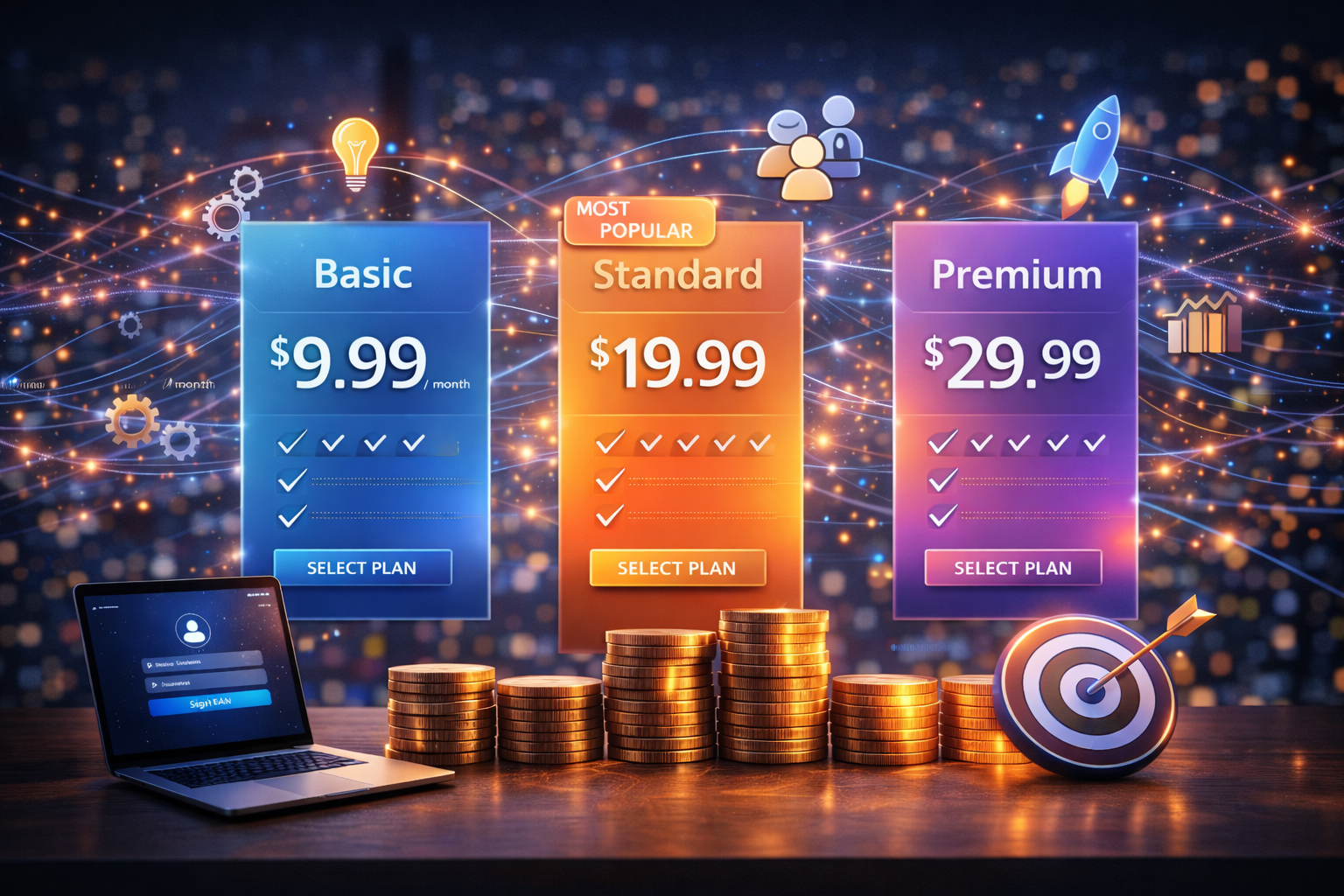
A complete guide explaining how SaaS pricing tiers work, including tier design, feature gating, pricing psychology, upgrades, downgrades, and how SaaS companies use tiers to drive growth and retention.
How SaaS Pricing Tiers Work
Understanding how SaaS pricing tiers work is essential for anyone building, buying, or scaling a subscription-based software product.
Nearly every SaaS product — from productivity tools to enterprise platforms — organizes pricing into tiers. These tiers determine:
- What customers pay
- What features they receive
- How users upgrade over time
- How revenue expands without constant acquisition
Yet most explanations focus only on what the tiers are, not why they exist or how they influence behavior.
This article explains how SaaS pricing tiers work as a system, not just a pricing table. We’ll break down:
- Why SaaS products use tiers at all
- How tiers are designed
- How features are gated
- How pricing tiers influence user behavior
- Why upgrades feel “natural” when done right
- Where SaaS pricing tiers fail — and why
What Are SaaS Pricing Tiers?
At a basic level, SaaS pricing tiers are different subscription plans offered at increasing price points, each providing access to more value.
However, that definition is incomplete.
A more accurate definition is:
SaaS pricing tiers are structured value segments designed to align different customer needs, willingness to pay, and usage levels into predictable revenue streams.
Understanding how SaaS pricing tiers work requires viewing them as segmentation tools, not just pricing options.
Why SaaS Companies Use Pricing Tiers
To understand how SaaS pricing tiers work, we must first understand the problems they solve.
Problem 1: Customers Are Not All the Same
SaaS users differ in:
- Company size
- Budget
- Use case
- Sophistication
- Frequency of use
A single price:
- Overcharges small users
- Undervalues large users
- Limits revenue potential
Pricing tiers solve this by enabling self-segmentation.
Problem 2: SaaS Value Is Ongoing
Unlike one-time purchases, SaaS delivers value:
- Continuously
- Incrementally
- Over time
Pricing tiers allow value and price to grow together as usage increases.
Problem 3: SaaS Growth Depends on Expansion
In SaaS, long-term growth comes from:
- Retention
- Upgrades
- Expansion revenue
Pricing tiers create built-in growth paths without requiring new customers.
When customers upgrade or downgrade subscription tiers during a billing cycle, many platforms adjust charges using proration. These billing adjustments are explained in what is proration in billing .
The Core Principle Behind How SaaS Pricing Tiers Work
At the heart of how SaaS pricing tiers work is one principle:
Different users derive different levels of value from the same product.
Pricing tiers exist to:
- Capture more value from high-value users
- Reduce friction for low-value users
- Allow customers to move between tiers as their needs change
This is not manipulation — it is alignment.
Common SaaS Pricing Tier Structures
Most SaaS products follow one of several tier structures.
Flat Tier Structure
Example:
- One plan
- One price
- All features included
Pros:
- Simple
- Low decision friction
Cons:
- Poor revenue optimization
- No upgrade path
Flat pricing works best for:
- Very focused tools
- Narrow audiences
- Early-stage products
Multi-Tier Pricing Structure
The most common SaaS model.
Example:
- Basic
- Pro
- Business
- Enterprise
Each tier unlocks additional value.
This structure is the backbone of how SaaS pricing tiers work at scale.
Freemium + Paid Tiers
A free tier introduces the product, while paid tiers monetize deeper value.
This structure emphasizes:
- Habit formation
- Gradual conversion
- Long-term expansion
Freemium works only when:
- The core value is quickly visible
- Paid tiers unlock important constraints
How Feature Gating Works in SaaS Pricing Tiers
Feature gating is the mechanical engine behind how SaaS pricing tiers work.
What Is Feature Gating?
Feature gating means:
- Certain features are available only at higher tiers
- Lower tiers have access limits or restrictions
However, effective feature gating is not about withholding value.
Good Feature Gating Principles
Effective feature gating:
- Preserves core value at lower tiers
- Restricts scale, not usefulness
- Encourages upgrades naturally
Bad feature gating:
- Cripples the product
- Creates frustration
- Increases churn
Common Feature Gating Dimensions
SaaS pricing tiers often gate:
- Usage limits (projects, seats, storage)
- Advanced features
- Automation capabilities
- Integrations
- Support levels
- Compliance or security features
Each dimension maps to increasing value, not arbitrary locks.
Usage-Based Constraints and Pricing Tiers
One of the most important aspects of how SaaS pricing tiers work is how they interact with usage.
Why Usage Is Often the Upgrade Trigger
Usage-based limits:
- Align price with value
- Scale naturally with customer success
- Create predictable upgrade moments
Examples:
- Number of users
- API calls
- Storage limits
- Workflows or automations
When users hit limits, upgrades feel earned, not forced.
Soft Limits vs Hard Limits
- Soft limits: Warnings before limits are reached
- Hard limits: Feature access stops
Soft limits:
- Preserve goodwill
- Encourage proactive upgrades
Hard limits:
- Create urgency
- Must be used carefully
Pricing Psychology in SaaS Tiers
Understanding how SaaS pricing tiers work also requires understanding psychology.
The “Most Popular” Tier Effect
Many pricing pages highlight a middle tier.
This works because:
- Users seek social proof
- Extremes feel risky
- The middle feels “safe”
This is guided choice, not deception.
Anchoring and Contrast
Higher tiers:
- Make lower tiers feel affordable
- Reframe value perception
Lower tiers:
- Reduce entry friction
- Increase trial adoption
The contrast is intentional.
Why Too Many Tiers Hurt Conversion
More choice increases:
- Cognitive load
- Decision paralysis
- Abandonment
Most successful SaaS pricing pages use 3–4 tiers max.
How SaaS Pricing Tiers Enable Upgrades
Upgrades are not accidents.
They are designed outcomes of how SaaS pricing tiers work.
Upgrade Triggers
Common triggers include:
- Hitting usage limits
- Needing advanced features
- Team growth
- Operational complexity
When tiers are designed correctly, upgrades feel like progress, not pressure.
Why Upgrades Are Easier Than New Sales
Upgrades:
- Build on trust
- Reduce acquisition cost
- Increase lifetime value
This is why SaaS businesses prioritize expansion revenue.
Some SaaS pricing models include additional costs such as seat minimums or overage charges that may not be obvious at first glance. These mechanisms are discussed in what are hidden fees in subscriptions .
Downgrades and Tier Flexibility
Understanding how SaaS pricing tiers work also means understanding downgrades.
Allowing downgrades:
- Reduces churn
- Preserves relationships
- Signals fairness
Blocking downgrades:
- Increases cancellations
- Erodes trust
Flexible tiers outperform rigid ones.
Common Mistakes in SaaS Pricing Tier Design
Many SaaS pricing tiers fail due to predictable mistakes:
- Too many features gated too early
- Confusing tier differences
- Arbitrary limits
- No clear upgrade path
- Misalignment with real user behavior
Most failures come from internal assumptions, not customer reality.
Seat-Based vs Usage-Based SaaS Pricing Tiers
A critical part of understanding how SaaS pricing tiers work is recognizing what actually scales as customers grow.
Two dominant scaling dimensions exist:
- Seats (users)
- Usage (consumption)
Many SaaS pricing tiers use one — or both.
Seat-Based Pricing Tiers
Seat-based tiers charge based on:
- Number of users
- Team size
- Licenses
Why seat-based tiers work
- Easy to understand
- Predictable revenue
- Naturally scale with organizational growth
Where seat-based tiers break
- Penalize collaboration
- Encourage credential sharing
- Misalign price with actual value
Seat-based pricing works best when each user independently creates value.
Usage-Based Pricing Tiers
Usage-based tiers scale with:
- API calls
- Data volume
- Transactions
- Automations
- Storage
Why usage-based tiers work
- Strong value alignment
- Fairness perception
- Scales with success
Where usage-based tiers break
- Revenue unpredictability
- Cost anxiety for users
- Higher cognitive load
This is why many SaaS products combine both.
Hybrid SaaS Pricing Tiers (The Modern Default)
Most modern SaaS products no longer rely on a single dimension.
Instead, hybrid pricing tiers combine:
- Base subscription
- Seats
- Usage limits
- Feature access
Understanding how SaaS pricing tiers work today means understanding hybrid design.
Why Hybrid Models Dominate
Hybrid tiers allow:
- Predictable baseline revenue
- Upside from customer growth
- Flexibility across segments
They reduce the weaknesses of pure seat-based or pure usage-based models.
Example Hybrid Structure
A typical hybrid tier might include:
- Base monthly price
- X included users
- Y included usage
- Overages or upgrade triggers
This structure feels:
- Familiar
- Fair
- Scalable
Enterprise SaaS Pricing Tiers Explained
Enterprise tiers are where how SaaS pricing tiers work becomes less transparent — but more strategic.
Why Enterprise Pricing Is “Contact Sales”
Enterprise customers differ in:
- Scale
- Compliance needs
- Security requirements
- Procurement processes
Fixed public pricing often fails here.
Enterprise tiers allow:
- Custom contracts
- Volume-based pricing
- Negotiated terms
- SLAs and guarantees
What Enterprise Tiers Typically Gate
Enterprise pricing tiers often unlock:
- Advanced security (SSO, SCIM)
- Audit logs
- Compliance certifications
- Dedicated support
- Custom integrations
These features map to organizational risk, not casual usage.
In mobile ecosystems, these feature unlocks are often implemented using in-app purchase systems, where users can upgrade their access directly within the application.
Why Enterprise Tiers Anchor the Pricing Page
Even for non-enterprise buyers:
- Enterprise tiers act as price anchors
- They reframe lower tiers as affordable
- They signal product maturity
Enterprise tiers influence perception across the entire funnel.
Add-Ons and Modular Pricing
Add-ons are another core mechanic in how SaaS pricing tiers work.
What Are SaaS Add-Ons?
Add-ons are:
- Optional features
- Paid separately from tiers
- Layered onto existing plans
They allow:
- Customization
- Revenue expansion
- Reduced tier complexity
When Add-Ons Make Sense
Add-ons work best when:
- A feature is valuable to a subset of users
- Bundling would inflate tier prices
- Usage is unpredictable
Poorly designed add-ons feel like nickel-and-diming.
Metrics Influenced by SaaS Pricing Tiers
Pricing tiers directly shape SaaS metrics.
Understanding how SaaS pricing tiers work requires seeing their metric impact.
Key Metrics Affected
Pricing tiers influence:
- ARPU (Average Revenue Per User)
- LTV (Lifetime Value)
- Expansion revenue
- Churn
- Conversion rates
A small tier change can ripple across all metrics.
Why Tier Design Affects Churn
Misaligned tiers cause churn when:
- Users outgrow value without upgrading
- Pricing jumps feel disproportionate
- Limits feel arbitrary
Good tier design minimizes forced churn.
Upgrade Timing and Behavioral Design
Well-designed SaaS pricing tiers trigger upgrades at moments of success, not frustration.
Success-Based Upgrade Moments
Best upgrade triggers include:
- Hitting productivity milestones
- Expanding teams
- Increased customer demand
Worst upgrade triggers:
- Sudden feature lockouts
- Unexpected hard stops
- Poorly communicated limits
Upgrades should feel like progress, not punishment.
Common SaaS Pricing Tier Failures (And Fixes)
Many SaaS pricing tiers fail in predictable ways.
Failure 1: Overcomplicated Pricing Pages
Symptoms:
- Too many tiers
- Too many features listed
- Confusing differences
Fix:
Reduce tiers. Increase contrast. Focus on outcomes.
Failure 2: Crippling Lower Tiers
Symptoms:
- Core value locked
- Poor trial experience
- Low activation
Fix:
Gate scale, not usefulness.
Failure 3: No Natural Upgrade Path
Symptoms:
- Users churn instead of upgrading
- Expansion revenue stagnates
Fix:
Tie limits to real success metrics.
Failure 4: Price Jumps Feel Unfair
Symptoms:
- Sharp churn at tier boundaries
- Negative feedback on pricing
Fix:
Introduce intermediate tiers or add-ons.
Recovering a Broken SaaS Pricing Tier Model
When pricing tiers fail, recovery is possible — but delicate.
Step 1: Observe Real Usage
Look at:
- Feature adoption
- Usage distribution
- Upgrade attempts
- Churn points
Pricing tiers must reflect actual behavior, not assumptions.
Step 2: Adjust Gradually
Abrupt pricing changes:
- Break trust
- Trigger backlash
Gradual adjustments:
- Preserve goodwill
- Allow adaptation
Step 3: Protect Existing Customers
Grandfathering:
- Reduces churn
- Preserves trust
- Signals fairness
New tiers should not punish loyal users.
How SaaS Pricing Tiers Evolve Over Time
No SaaS pricing tier model is permanent.
As products mature:
- Early tiers simplify adoption
- Mid-stage tiers optimize growth
- Later tiers maximize value capture
Understanding how SaaS pricing tiers work long-term requires accepting evolution.
Mental Models for Understanding How SaaS Pricing Tiers Work
To reason clearly about SaaS pricing tiers, keep these models in mind:
- Tiers are segmentation tools, not feature lists
- Upgrades should follow success, not friction
- Good tiers feel fair at every level
- Pricing influences behavior, not just revenue
- Tier design is never “done”
Frequently Asked Questions About How SaaS Pricing Tiers Work
How many pricing tiers should a SaaS product have?
Most successful SaaS products use 3–4 tiers.
Should SaaS pricing tiers be public?
Yes for SMB products; enterprise often requires flexibility.
Do freemium tiers hurt paid conversions?
Only when the free tier delivers full value without limits.
Is usage-based pricing better than tiered pricing?
Not always. Hybrid models often perform best.
Conclusion: How SaaS Pricing Tiers Work in Practice
Understanding how SaaS pricing tiers work reveals that pricing is not about extracting more money — it’s about aligning value with growth.
Well-designed SaaS pricing tiers:
- Welcome new users
- Support growing teams
- Encourage success-based upgrades
- Preserve trust
- Scale revenue sustainably
Poorly designed tiers do the opposite.
When pricing tiers are treated as a product system, not a spreadsheet, they become one of the most powerful growth levers in SaaS.
External references
- Stripe Documentation — Subscription Pricing Models — A technical overview of tiered and usage-based subscription structures.
- SaaStr — SaaS Pricing Models Explained — A neutral overview of common SaaS pricing structures and tradeoffs.
Pricing Experiments and A/B Testing in SaaS Pricing Tiers
A critical but often invisible part of how SaaS pricing tiers work is experimentation.
Very few successful SaaS pricing models are designed perfectly the first time. Instead, they evolve through controlled experiments.
Why SaaS Companies Experiment With Pricing Tiers
SaaS companies experiment because:
- Customer behavior is unpredictable
- Willingness to pay varies widely
- Small changes can have large revenue effects
Pricing tiers are hypotheses, not facts.
What SaaS Companies Test
Common pricing experiments include:
- Number of tiers
- Feature placement between tiers
- Price points
- Monthly vs annual emphasis
- Usage limits
- Upgrade prompts
Each test helps refine how SaaS pricing tiers work for a specific audience.
Why Pricing Experiments Are Risky
Pricing tests can:
- Confuse users
- Create perceived unfairness
- Trigger backlash if exposed publicly
This is why many SaaS companies:
- Segment experiments by cohort
- Avoid drastic price swings
- Protect existing customers
Grandfathering and Experimentation
A key rule in SaaS pricing experiments:
Never punish loyal customers.
Grandfathering existing users:
- Preserves trust
- Reduces churn
- Allows testing without long-term damage
International SaaS Pricing Tiers and Localization
Understanding how SaaS pricing tiers work globally adds another layer of complexity.
Why Global Pricing Is Hard
Customers across regions differ in:
- Purchasing power
- Currency stability
- Payment preferences
- Tax and compliance requirements
A single global price often fails.
Localized Pricing Tiers
Localized SaaS pricing tiers may include:
- Regional pricing adjustments
- Local currencies
- Different plan bundles
- Region-specific payment methods
Localization increases conversion but adds operational overhead.
Currency and Psychological Pricing
Even small changes matter:
- $10 feels different from €10
- Local price anchors influence perception
- Rounding affects trust
Localization is not just math — it’s psychology.
Taxes and Compliance in SaaS Pricing Tiers
Pricing tiers must account for:
- VAT
- Sales tax
- Digital service taxes
These affect:
- Displayed price
- Billing logic
- User trust
Poor tax handling damages conversion and retention.
Ethical Considerations in How SaaS Pricing Tiers Work
As SaaS pricing tiers grow more sophisticated, ethical questions emerge.
Dark Patterns vs Fair Design
Unethical tier practices include:
- Hiding essential features
- Forcing upgrades through frustration
- Obscuring downgrade paths
- Making cancellation difficult
These may increase short-term revenue but harm long-term trust.
Fairness Perception in Pricing Tiers
Users tolerate higher prices when:
- Tier differences are clear
- Pricing changes are communicated
- Downgrades are allowed
- Value increases justify cost
Ethical pricing is often better business.
Transparency as a Competitive Advantage
SaaS companies that clearly explain:
- Why tiers exist
- What changes between plans
- How upgrades work
Often see:
- Lower churn
- Higher trust
- Better word-of-mouth
Transparency reinforces how SaaS pricing tiers work in users’ minds.
Advanced SaaS Pricing Tier Patterns
As SaaS products mature, pricing tiers become more nuanced.
Outcome-Based Tiering
Some SaaS products price tiers based on:
- Results delivered
- Outcomes achieved
- Business impact
This aligns price directly with value but requires strong measurement.
Role-Based Pricing Tiers
Instead of features, tiers differentiate by:
- User role
- Permissions
- Access levels
This works well in:
- Enterprise tools
- Workflow systems
- Compliance-heavy products
Vertical-Specific Pricing Tiers
Some SaaS companies create tiers for:
- Specific industries
- Use cases
- Regulatory environments
Vertical tiers increase relevance but reduce generality.
How SaaS Pricing Tiers Fail at Scale
Understanding how SaaS pricing tiers work also means understanding how they break under growth.
Scaling Failure 1: Tier Drift
Over time:
- Features pile up
- Boundaries blur
- Tiers lose meaning
Users can’t tell why tiers differ.
Solution:
Periodic tier audits and pruning.
Scaling Failure 2: Legacy Customers on Old Plans
Long-lived SaaS companies accumulate:
- Many pricing versions
- Inconsistent entitlements
- Support complexity
Solution:
Gradual migration paths and consolidation.
Scaling Failure 3: Expansion Without Clarity
Adding:
- Too many add-ons
- Too many limits
- Too many exceptions
Creates pricing chaos.
Solution:
Return to core value metrics.
Case-Pattern Synthesis (Non-Brand-Specific)
Across industries, successful SaaS pricing tiers share patterns:
- Clear entry-level value
- Predictable upgrade triggers
- Fair price-to-value jumps
- Flexible downgrade paths
- Transparent communication
Failures cluster around:
- Arbitrary limits
- Overly clever pricing
- Punitive gating
These patterns hold regardless of market or size.
How SaaS Pricing Tiers Evolve Across Company Stages
Understanding how SaaS pricing tiers work over time requires recognizing lifecycle stages.
Early Stage
Focus:
- Adoption
- Simplicity
- Learning
Pricing tiers are minimal and forgiving.
Growth Stage
Focus:
- Expansion
- Segmentation
- Optimization
Pricing tiers become more structured and strategic.
Mature Stage
Focus:
- Value capture
- Retention
- Enterprise revenue
Pricing tiers maximize lifetime value without sacrificing trust.
Mental Models for Mastering How SaaS Pricing Tiers Work
To think clearly about SaaS pricing tiers, use these models:
- Tiers are value segments, not feature bundles
- Upgrades should follow success, not pain
- Pricing is behavior design
- Trust compounds faster than revenue
- Pricing systems must evolve
These mental models unify everything discussed.
Extended FAQs About How SaaS Pricing Tiers Work
Can SaaS pricing tiers hurt conversion?
Yes — if they are confusing or feel unfair.
Is freemium always necessary?
No. It works best when time-to-value is short.
Should SaaS pricing tiers change often?
They should evolve — but not constantly.
Do cheaper tiers reduce enterprise sales?
Usually no. They expand the funnel.
Final System-Level Synthesis
At scale, SaaS pricing tiers behave like control systems.
They:
- Observe user behavior
- Respond to growth signals
- Adjust incentives
- Balance revenue and trust
Poor systems overcorrect.
Good systems stabilize growth.
Understanding how SaaS pricing tiers work means understanding them as living systems, not static tables.
Conclusion: How SaaS Pricing Tiers Work in the Real World
SaaS pricing tiers work when they:
- Respect user diversity
- Scale with success
- Encourage growth naturally
- Preserve fairness
- Adapt over time
They fail when:
- Value is obscured
- Limits feel arbitrary
- Trust is sacrificed for short-term gain
When designed thoughtfully, SaaS pricing tiers become one of the most powerful — and least visible — growth engines in software.
Understanding how SaaS pricing tiers work gives builders and buyers the clarity to design, choose, and evolve pricing systems that last.
Many SaaS platforms use recommendation algorithms to suggest features, tools, or integrations to users within different pricing tiers. These systems are explained in how recommendation algorithms work .