
27/03/2026
How End-to-End Encryption Works (Powerful Guide + 7 Simple Examples Explained)
A complete guide to End-to-End Encryption (E2EE). Learn how public and private keys work together to ensure your messages remain strictly confidential.
When you send a private message on WhatsApp or Signal, you expect it to stay between you and the recipient. That privacy is entirely thanks to End-to-End Encryption (E2EE).
Let’s dive into the cryptographic locks and keys that make it mathematically impossible for even the messaging companies themselves to read your private chats.
What Is End-to-End Encryption? (Complete Beginner to Advanced Explanation)
Simple Definition (Plain Language First)
End-to-end encryption (E2EE) is a way of protecting data so that only the sender and the receiver can read it—no one else in between.
Not:
- The app
- The company
- The internet provider
- Hackers
Only the two endpoints.
In this topic
- What Is DNS and How It Works
- What Is DNS and How It Works
- What Is a CDN and How It Works (Edge Servers, Caching, and Global Content Delivery)
- How Cloud Storage Works (Distributed Systems, Data Replication, and File Storage Explained)
- How API Requests Work (Ultimate Guide + 12 Powerful Concepts Explained Simply)
- What Is Zero Trust Security (Powerful Guide + 9 Key Principles Explained Simply)
More infrastructure explanations will be added over time.
If someone intercepts the message, all they see is random unreadable data.
End-to-end encryption (E2EE) is a method that ensures only the sender and receiver can read a message. According to Cloudflare, it prevents intermediaries from accessing data during transmission.
For a deeper technical overview, you can explore this detailed explanation from Cloudflare:
https://www.cloudflare.com/en-gb/learning/privacy/what-is-end-to-end-encryption
The Core Idea (What Makes It Different)
Most people think encryption means “secure.” That’s only partly true.
The real power of end-to-end encryption is this:
➡️ No middleman can decrypt your data—even if they want to.
That includes:
- Servers storing your messages
- Companies running the app
- Governments requesting access
This is what makes E2EE fundamentally different from regular encryption.
A Strong Mental Model (How to Think About It)
Think of E2EE like this:
- You write a message
- You lock it with a key only your friend can open
- You send it through a chain of strangers
- None of them can unlock it
Even better:
- Each message uses new keys
- Old messages remain secure even if something goes wrong later
This concept is called forward secrecy (we’ll cover it later in depth).
How End-to-End Encryption Works (Step-by-Step, Deep Dive)
Let’s break it down beyond the usual surface explanation.
Step 1: Key Creation (The Foundation of Everything)
Before you even send a message, your device generates two keys:
- Public Key → Shared with others
- Private Key → Stored securely on your device
These keys are mathematically linked but cannot be reversed.
Why This Matters:
- Anyone can use your public key to encrypt a message
- Only your private key can decrypt it
This creates a secure one-way system
Step 2: Secure Key Exchange (The Hidden Magic)
When you start a conversation, your app:
- Fetches the recipient’s public key
- Uses cryptographic protocols to establish a shared secret
This happens instantly and invisibly.
Behind the scenes, protocols like:
- Diffie-Hellman key exchange
- Double Ratchet algorithm
are often used.
Step 3: Message Encryption (Before It Leaves Your Device)
When you hit send:
- Your message is converted into ciphertext
- Encryption happens locally on your device
- The original message is never sent in readable form
This is critical:
➡️ The internet never sees your real message
Step 4: Transmission (Across the Internet)
Your encrypted message travels through:
- Routers
- Servers
- Data centers
Even if intercepted, it looks like:
XJ92KDL!@#8sdfLKSJ…
Completely useless without the key.
Step 5: Decryption (Only at the Destination)
When the message reaches the recipient:
- Their private key decrypts it
- The message becomes readable again
No one else has access to that private key.
Public Key vs Private Key (Fully Explained with Intuition)
Public Key (The Open Lock)
Your public key is like a lock you give to the world.
Anyone can:
- Use it
- Encrypt messages for you
But they cannot unlock anything with it.
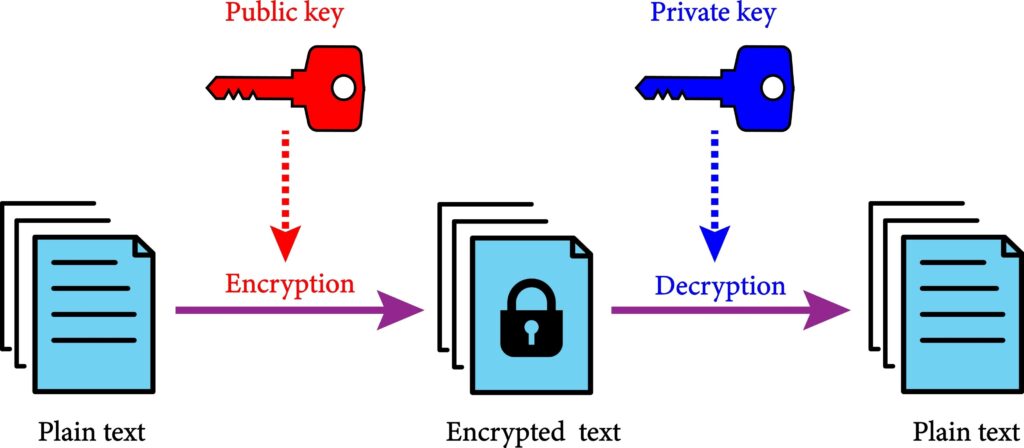
Private Key (The Only Key That Matters)
Your private key:
- Never leaves your device
- Is used to decrypt messages
- Must stay secret at all times
If someone gets your private key:
➡️ They can read your messages
How They Work Together (Simple Flow)
- Sender uses your public key
- Message becomes encrypted
- Only your private key can decrypt it
This system is called asymmetric encryption
7 Simple Examples of End-to-End Encryption (Real-World Scenarios)
1. Sending a WhatsApp Message
When you send a message:
- It’s encrypted instantly
- Even WhatsApp cannot read it
- Only the recipient can
2. Using Signal for Private Chats
Apps like Signal take E2EE further by:
- Minimizing metadata
- Using open-source encryption
3. Sharing a Password Securely
Password managers use E2EE so:
- Even the company can’t see your passwords
4. Sending Photos Privately
Images are encrypted the same way as text.
Even if intercepted:
➡️ They cannot be viewed
5. Encrypted Video Calls
Your voice and video are:
- Encrypted in real time
- Decrypted only by the recipient
6. Secure File Sharing
Some tools allow:
- Uploading encrypted files
- Sharing access only with specific users
7. Backup Encryption
Some services encrypt backups so:
- Only you can restore them
Symmetric vs Asymmetric Encryption (Why Both Are Used)
Symmetric Encryption (Fast but Limited)
- Uses one key
- Very fast
- Used for large data
Problem:
➡️ How do you share the key securely?
Asymmetric Encryption (Secure but Slower)
- Uses public/private keys
- Solves key sharing problem
- Slower than symmetric encryption
Why Modern Systems Combine Both
Here’s the trick:
- Use asymmetric encryption to exchange a key
- Use symmetric encryption for the actual data
This gives:
- Speed
- Security
End-to-End Encryption vs Regular Encryption
| Feature | Regular Encryption | End-to-End Encryption |
|---|---|---|
| Data readable on server | Yes | No |
| Who can access data | Service + user | Only users |
| Risk level | Medium | Very low |
| Trust required | High | Minimal |
Advantages of End-to-End Encryption (Expanded)
1. True Privacy
No third party can access your content.
2. Protection from Data Breaches
Even if servers are hacked:
➡️ Data remains unreadable
3. Reduced Trust Dependency
You don’t need to trust companies with your data.
4. Strong Security by Design
Security is built into the system—not added later.
Limitations of End-to-End Encryption (Honest View)
1. Metadata Still Exists
Even with E2EE, some data may be visible:
- Who you talk to
- When you talk
- How often
2. Device Security Is Critical
If your device is compromised:
➡️ Encryption won’t help
3. Key Management Problems
Lose your private key:
➡️ You lose access to your data
4. Not Fully Anonymous
E2EE protects content—not identity.
FAQs (Expanded Section)
1. What does end-to-end encryption mean in simple terms?
It means only the sender and receiver can read the message.
2. Can companies see encrypted messages?
No, not if true end-to-end encryption is used.
3. Is end-to-end encryption hackable?
Breaking encryption is extremely difficult. Most attacks target devices instead.
4. Does E2EE protect against all threats?
No—it protects data in transit, not compromised devices.
5. Why don’t all apps use end-to-end encryption?
Because it limits data access, analytics, and monetization.
6. Is end-to-end encryption used in banking?
Yes, often combined with other security layers.
Conclusion (Strong Wrap-Up)
End-to-end encryption is one of the most important technologies behind modern internet privacy. It ensures that your data remains private, secure, and accessible only to the people you choose.
Understanding how end-to-end encryption works helps you:
- Choose safer apps
- Protect your data
- Make informed decisions online
In a world where data is constantly moving, E2EE acts as your digital shield.
The Hidden Layer: Session Keys
When you send a message, your app doesn’t just use your public/private key directly.
Instead, it creates something called a session key.
What is a Session Key?
A session key is:
- A temporary encryption key
- Used only for a short time (or even one message)
- Extremely fast and efficient
Why Session Keys Exist
Using public/private keys alone would be:
- Too slow
- Too heavy for real-time messaging
So modern systems do this:
- Use asymmetric encryption to securely share a session key
- Use symmetric encryption (session key) to encrypt the message
This gives you:
✔ Speed
✔ Security
✔ Efficiency
A Simple Flow (Putting It Together)
Here’s what really happens when you send a message:
- Your app generates a session key
- It encrypts the message using that session key
- It encrypts the session key using the recipient’s public key
- Both are sent together
- The recipient:
- Uses their private key to unlock the session key
- Uses the session key to decrypt the message
This layered approach is what makes E2EE both fast and secure.
Forward Secrecy (Why Old Messages Stay Safe)
This is one of the most important concepts—and one most articles skip.
What Is Forward Secrecy?
Forward secrecy means:
➡️ Even if someone gets your keys today, they cannot decrypt your old messages
How This Works
Instead of using the same keys forever:
- New keys are generated constantly
- Often for every message or session
So:
- Each message is independently protected
- Breaking one message doesn’t break others
Why This Matters (Real Example)
Imagine a hacker gets access to your device today.
Without forward secrecy:
- They could decrypt all past messages
With forward secrecy:
- They can only access future messages (if at all)
Your history stays protected.
The Double Ratchet Algorithm (Explained Simply)
This sounds complicated—but we’ll keep it simple.
What Is the Double Ratchet?
It’s a system used by apps like Signal that:
- Constantly updates encryption keys
- Makes every message more secure than the last
Why It’s Called “Double Ratchet”
Think of a ratchet like a gear that only moves forward.
This system uses two ratchets:
- One for sending messages
- One for receiving messages
Each message:
- Advances the ratchet
- Creates a new key
Why This Is Powerful
- Keys are never reused
- Messages cannot be retroactively decrypted
- Even partial compromises don’t break the system
What Happens If Someone Tries to Intercept Your Message?
Let’s walk through a real attack scenario.
Scenario: Man-in-the-Middle Attack
A hacker tries to intercept your message between you and the recipient.
Without End-to-End Encryption
The attacker can:
- Read the message
- Modify it
- Forward it
With End-to-End Encryption
The attacker sees:
- Encrypted data only
- No usable information
Even if they try to alter the message:
➡️ It fails integrity checks and gets rejected
Why This Works
Because:
- The attacker doesn’t have the private key
- They cannot decrypt or re-encrypt properly
Message Integrity (How You Know It Wasn’t Changed)
Encryption isn’t just about secrecy—it’s also about trust.
What Is Message Integrity?
It ensures that:
➡️ The message you receive is exactly what was sent
How It Works
Each message includes:
- A cryptographic signature or hash
If anything changes:
- The hash no longer matches
- The message is rejected
Why This Matters
It protects against:
- Tampering
- Fake messages
- Data corruption
Authentication (How You Know Who You’re Talking To)
Encryption alone isn’t enough—you also need identity verification.
The Problem
What if someone pretends to be your contact?
The Solution: Key Verification
Apps solve this by:
- Linking keys to identities
- Allowing users to verify fingerprints
Example
In secure apps, you can:
- Compare security codes
- Scan QR codes
This ensures:
➡️ You are talking to the real person
End-to-End Encryption vs HTTPS vs VPN (Clear Comparison)
This is critical for your cluster because it connects your articles together.
End-to-End Encryption
- Protects message content
- Only sender and receiver can read it
HTTPS (Transport Encryption)
- Protects data between you and a server
- The server can still read the data
VPN
- Hides your internet traffic from your ISP
- Does NOT encrypt data end-to-end
Comparison Table
| Feature | E2EE | HTTPS | VPN |
|---|---|---|---|
| Protects content from service | ✅ | ❌ | ❌ |
| Protects data in transit | ✅ | ✅ | ✅ |
| Hides activity from ISP | ❌ | ❌ | ✅ |
| Prevents server access | ✅ | ❌ | ❌ |
Common Misconceptions About End-to-End Encryption
Myth 1: “Encryption makes you anonymous”
Not true.
E2EE protects:
- Content
But not always:
- Identity
- Metadata
Myth 2: “Encrypted apps are 100% safe”
Also not true.
If your device is compromised:
➡️ Messages can still be accessed
Myth 3: “Only criminals use encryption”
Completely false.
Encryption is used by:
- Businesses
- Governments
- Banks
- Everyday users
Where End-to-End Encryption Is Used Today (Expanded)
1. Messaging Apps
Used in:
- Private chats
- Group conversations
- Voice/video calls
2. Cloud Storage (Advanced Use Cases)
Some platforms offer:
- Client-side encryption
- Zero-knowledge storage
Meaning:
➡️ Even the provider cannot access your files
3. Password Managers
Your vault is:
- Encrypted locally
- Only unlocked with your master password
4. Secure Collaboration Tools
Used by:
- Remote teams
- Enterprises
- Developers
The Future of End-to-End Encryption
Trend 1: Default Encryption Everywhere
More apps are making E2EE the default—not optional.
Trend 2: Zero-Knowledge Systems
Services are moving toward:
➡️ Knowing nothing about user data
Trend 3: Post-Quantum Encryption
Future systems will protect against:
- Quantum computer attacks
FAQs (Extended Section)
7. Does end-to-end encryption slow down apps?
Not significantly. Modern systems are optimized for speed.
8. Can governments bypass end-to-end encryption?
Not directly. They usually rely on device access instead.
9. What is the difference between encryption and hashing?
Encryption can be reversed (with a key). Hashing cannot.
10. Is email end-to-end encrypted by default?
No, most email services do not use E2EE by default.
11. Can encrypted messages be recovered?
Only if you have the correct keys or backups.
12. Why is key management so important?
Because losing keys means losing access permanently.
Conclusion (Extended Final Thoughts)
End-to-end encryption is not just a feature—it’s a fundamental shift in how digital privacy works.
It removes the need to trust:
- Platforms
- Servers
- Networks
And replaces it with:
➡️ Mathematical certainty
By understanding how end-to-end encryption works, you gain more than knowledge—you gain control over your digital life.
Real-World Attack Scenarios (And How End-to-End Encryption Stops Them)
To truly understand how end-to-end encryption works, you need to see what it protects against in the real world.
1. Public Wi-Fi Attack (Coffee Shop Scenario)
The Risk
You connect to public Wi-Fi at a café. A hacker on the same network tries to intercept your data.
Without encryption:
- They can see your messages
- They can steal login details
- They can track your activity
With End-to-End Encryption
Even if the attacker captures your data:
- It’s fully encrypted
- It looks like random noise
- It cannot be decoded
➡️ Your message stays private
2. Compromised Server Attack
The Risk
A company’s servers get hacked.
Without E2EE:
- Hackers can access stored messages
- Entire databases can be leaked
With End-to-End Encryption
Servers only store:
- Encrypted data
They do NOT have:
- The keys to decrypt it
➡️ Even a full breach reveals nothing useful
3. Government Surveillance Scenario
The Risk
Authorities request access to user data from a company.
With Standard Encryption
Companies may:
- Decrypt and provide data
With End-to-End Encryption
Companies can only provide:
- Encrypted data
They cannot decrypt it, even if required.
4. Data Interception During Transmission
The Risk
Data travels across multiple networks:
- ISPs
- Routers
- International servers
Each point is a potential interception spot.
With End-to-End Encryption
Every intercepted packet is:
- Encrypted
- Useless
Visualizing End-to-End Encryption (Mental Models That Stick)
Understanding E2EE becomes easier with the right mental models.
Model 1: The Locked Box Chain
- You lock a box with a unique key
- Only the receiver has the matching key
- The box passes through many hands
No one else can open it.
Model 2: Changing Locks Every Time
Imagine:
- Every message uses a new lock
- Old locks are destroyed
Even if someone finds a key later:
➡️ It won’t work on past messages
Model 3: Secret Language That Changes Constantly
You and your friend:
- Speak in a coded language
- Change the code after every sentence
No outsider can keep up.
Deep Dive: What Happens Inside Your Device
Most people think encryption happens “on the internet.”
It doesn’t.
Everything Starts on Your Device
Your phone or computer:
- Generates keys
- Encrypts messages
- Decrypts messages
The internet only carries:
➡️ Encrypted data
Secure Storage of Keys
Private keys are stored in:
- Secure enclaves
- Protected memory areas
Modern devices isolate these keys so:
➡️ Even apps can’t access them directly
Why Device Security Matters So Much
If someone:
- Installs malware
- Gains physical access
They could:
- Read messages before encryption
- Read messages after decryption
➡️ Encryption cannot protect against this
End-to-End Encryption in Group Chats (More Complex Than You Think)
Group chats introduce new challenges.
The Problem
Instead of 1-to-1 communication:
- You now have multiple participants
- Each needs secure access
How It Works
For each participant:
- Messages are encrypted separately
- Each user has their own key
So if there are 5 people:
➡️ The message may be encrypted 5 times
What Happens When Someone Joins or Leaves
- New keys are generated
- Old keys are discarded
This ensures:
➡️ Past messages remain secure
Metadata: The One Thing Encryption Doesn’t Fully Hide
Even with E2EE, some data can still be visible.
What Is Metadata?
Metadata is information about communication, such as:
- Who you talk to
- When you send messages
- How often you communicate
Why It Matters
Even without message content, metadata can reveal:
- Relationships
- Behavior patterns
- Activity timelines
How Apps Reduce Metadata
Privacy-focused apps try to:
- Minimize stored metadata
- Use techniques like “sealed sender”
But complete elimination is difficult.
Key Management (The Most Overlooked Challenge)
Encryption is only as strong as how keys are handled.
Why Keys Are Everything
Keys control:
- Access to messages
- Ability to decrypt data
Lose your key:
➡️ You lose access permanently
Common Key Management Methods
1. Device-Based Storage
Keys stay on your device.
Pros:
- Maximum privacy
Cons:
- Risk of loss
2. Backup Systems
Some services allow:
- Encrypted backups
- Recovery using passwords
3. Multi-Device Sync
Keys are securely shared across:
- Phones
- Laptops
- Tablets
What Happens When You Switch Devices?
This is a real-world situation many users don’t think about.
The Challenge
Your encryption keys are tied to your device.
When you switch devices:
- You need to transfer or regenerate keys
Secure Migration Process
Apps may:
- Verify identity
- Transfer keys securely
- Re-establish encrypted sessions
Potential Risks
If not handled properly:
- Messages could become inaccessible
- Security could be weakened
End-to-End Encryption vs Zero Trust Security (High-Level Connection)
This ties into another article in your cluster.
End-to-End Encryption Focus
- Protects data in transit
- Ensures only endpoints can read it
Zero Trust Security Focus
- Assumes no system is trusted
- Verifies everything continuously
How They Work Together
E2EE is often part of a zero-trust model:
- Data is always encrypted
- Access is always verified
Why Some Companies Avoid Full End-to-End Encryption
This is an important (and often hidden) reality.
1. Loss of Data Access
With E2EE:
- Companies cannot read user data
This affects:
- Analytics
- Personalization
- Advertising
2. Moderation Challenges
Platforms cannot:
- Easily detect harmful content
- Monitor conversations
3. Complexity and Cost
Implementing E2EE requires:
- Advanced cryptography
- Secure infrastructure
- Ongoing maintenance
The Role of Open Source in Encryption Trust
Trust is critical in encryption.
Why Open Source Matters
Open-source encryption:
- Can be inspected by experts
- Can be verified publicly
This reduces the risk of:
- Hidden backdoors
- Weak implementations
Closed Source Concerns
With closed systems:
- You must trust the company
- You cannot verify the code
Advanced Concept: Perfect Forward Secrecy vs Standard Encryption
Let’s go one level deeper.
Standard Encryption
- Uses long-term keys
- If compromised, past data may be exposed
Perfect Forward Secrecy
- Uses temporary keys
- Keys are constantly rotated
Result:
➡️ Past communication remains safe
Extended FAQs (Final Additions)
13. Can end-to-end encryption be turned off?
Yes, depending on the app—but many apps enable it by default.
14. Does E2EE protect cloud backups?
Not always—some backups are not end-to-end encrypted.
15. Is E2EE used in video calls?
Yes, many apps use it for real-time communication.
16. What is “zero-knowledge encryption”?
It means the provider knows nothing about your data.
17. Can encrypted data be brute-forced?
In theory yes, but modern encryption makes it practically impossible.
18. Why is encryption important for businesses?
It protects:
- Customer data
- Intellectual property
- Internal communication
Final Conclusion (Ultimate Wrap-Up)
End-to-end encryption is one of the most powerful technologies shaping the modern internet.
It transforms security from:
- Trust-based → math-based
It ensures that:
- Your data belongs to you
- Your conversations stay private
- Your digital life is protected
In a world where data is constantly moving and threats are always evolving, understanding how end-to-end encryption works is no longer optional—it’s essential.
Share this post with your friends